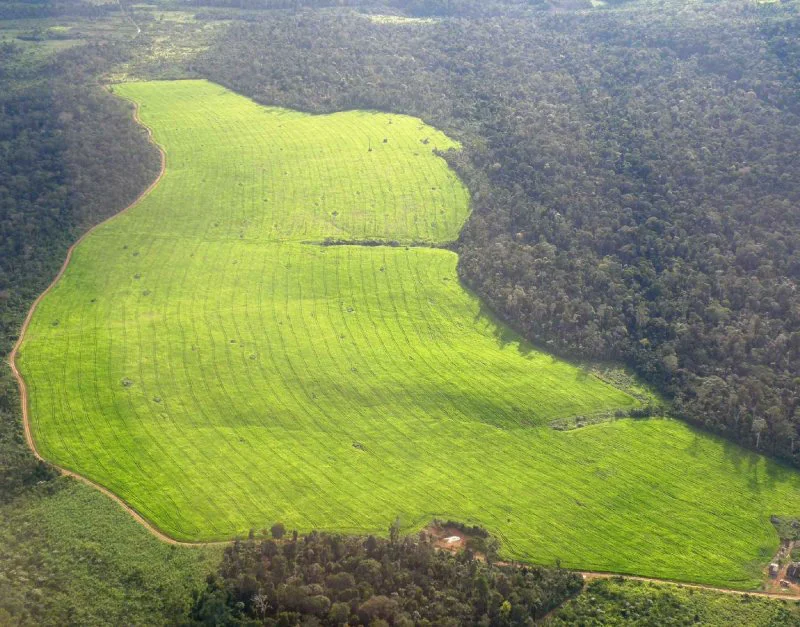
The Amazon basin includes 550 Mha covered with rainforests, and 60% of this area is in Brazil. The conversion of rainforest for soybean production raises concerns about how Brazil can reconcile production and environmental goals. Here we investigated the degree to which intensification could help Brazil produce more soybean without further encroachment on the Amazon forest. Our analysis shows that the continuation of current trends in soybean yield and area would lead to the conversion of an additional 5.7 Mha of forests and savannahs during the next 15 years, with an associated 1,955 Mt of CO2e released into the atmosphere. In contrast, the acceleration of yield improvement, coupled with the expansion of soybean area only in areas currently used for livestock production, would allow Brazil to produce 162 Mt of soybean without deforestation and with 58% lower global climate warming relative to that derived from the continuation of current trends.















 Viewpoint — Fact checking MAHA mythmakers: How wellness influencers and RFK, Jr. undermine American science and health
 Viewpoint: Video — Big Solar is gobbling up productive agricultural land and hurting farmers yet providing little energy or sustainabilty gains
 Fighting deforestation with CO2: Biotechnology breakthrough creates sustainable palm oil alternative for cosmetics
 Trust issues: What happens when therapists use ChatGPT?
 California, Washington, Oregon forge immunization alliance to safeguard vaccine access against federal undermining
 30-year-old tomato line shows genetic resistance to devastating virus
 The free-range chicken dilemma: Better for birds, but with substantial costs
 ‘You have to treat the brain first’: Rethinking chronic pain with Sanjay Gupta