Breakthrough Dual-Laser Technique Reduces Brillouin Sensing Frequency to 200 MHz
Breakthrough Dual-Laser Technique Reduces Brillouin Sensing Frequency to 200 MHz
Breakthrough in Optical Fiber Sensing: Using Dual-Laser Technology for Enhanced Brillouin Measurements
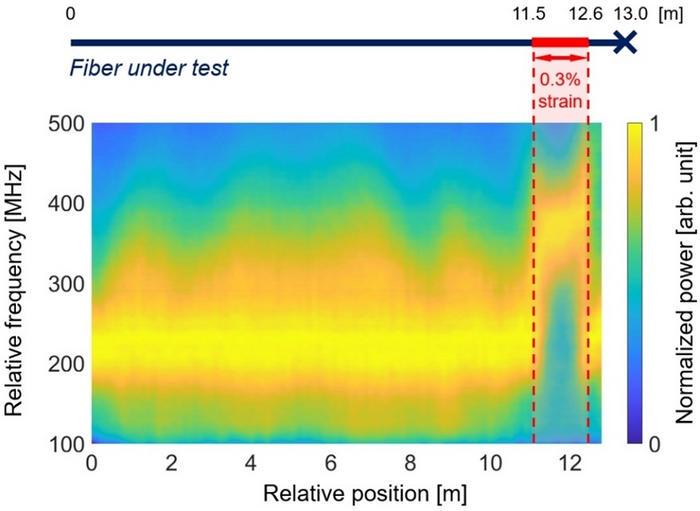
In an exciting development that could revolutionize the field of optical fiber sensing, researchers at YOKOHAMA National University have unveiled a new dual-laser system that enhances the capabilities of Brillouin optical correlation-domain reflectometry (BOCDR). This innovative technique utilizes two frequency-modulated lasers to accurately measure strain and temperature across lengths of optical fiber, thereby streamlining applications in structural health monitoring and other industrial scenarios. This proof-of-concept experiment, conducted on a 13-meter single-mode silica fiber, presents promising advancements over conventional systems, offering practicality in real-world healthcare and engineering settings.
The Brillouin effect—an interaction between light and acoustic waves in a medium—has long been exploited for distributed sensing of strain and temperature. However, previous BOCDR systems presented significant challenges, such as the need for a physical delay line in the measurement arm, which adds bulk and complexity. By scanning the relative modulation phase of the two lasers, researchers have successfully circumvented this limitation, making it easier for engineers to deploy systems that can monitor structural integrity over long periods.
Notably, the Brillouin signal typically exists at a frequency near 11 GHz, requiring expensive wide-band electrical devices to analyze. The new dual-laser BOCDR shifts this operational range into a more manageable 200 MHz, where standard radio-frequency equipment can operate efficiently. This dramatic reduction in signal bandwidth not only cuts costs but also enhances accessibility for engineers looking to install such monitoring systems in environments where precision and reliability are paramount.
With their approach, the researchers have also addressed issues with spatial resolution that often plague traditional systems. Previous technologies often experienced fluctuations in spatial resolution when the laser-modulation frequency was swept during signal acquisition. However, by maintaining a constant modulation frequency throughout the scanning process, the team achieved stable spatial resolution along the fiber. Their measurements indicate that these improvements allow for a consistent resolution of approximately 0.36 meters across the optical fiber, enabling engineers to pinpoint variations in strain or temperature with unprecedented reliability.
The potential applications for this dual-laser BOCDR system extend beyond infrastructure monitoring. The technology is relevant in diverse fields such as factory process control, aerospace, and environmental monitoring. Each of these industries demands precise, real-time data, and the advancements made by the YOKOHAMA research team provide a practical tool for meeting those needs.
Looking ahead, the team has outlined further developments they intend to pursue. Key priorities include increasing the scan rate of their system, extending the sensing range beyond the current capacity of a few dozen meters, and enhancing their laser stabilization techniques to ensure long-term accuracy. These improvements will augment the technology’s reliability, enabling it to handle more extensive and varied monitoring scenarios, thus broadening its applicability in both research and industry.
The health and safety implications of this research cannot be understated. As infrastructure like bridges and tunnels deteriorate over time, effective monitoring systems become crucial to prevent catastrophic failures. This dual-laser technology provides a solution that can be deployed in single-ended fiber access situations, which is often necessary in dense urban environments where multiple access points may not be feasible. The ability to confidently monitor strain and temperature with this new system directly contributes to safer public structures.
In terms of collaborative efforts, the research team includes various experts from partner institutions, including The University of Tokyo and NTT Corporation. Their interdisciplinary collaboration underscores the importance of merging diverse areas of expertise to navigate and solve complex engineering challenges. Funding provided by the Japan Society for the Promotion of Science (JSPS) supports the research, further highlighting its significance in advancing scientific inquiry.
These advancements in dual-laser BOCDR technology mark a significant milestone in optical fiber sensing. By offering a simpler, more accessible alternative to traditional systems, the innovation stands to not only improve monitoring capabilities but also democratize the technology for broader usage across various fields. As the researchers at YOKOHAMA National University continue to refine and test their system, the anticipation surrounding the practical applications of their work grows.
The implications of this research extend into future technological advancements. The dual-laser BOCDR system represents the next step in the evolution of optical sensing technologies, emphasizing the role of innovation in scientific research. As researchers pave the way for applications that can directly impact safety and sustainability, the excitement surrounding this breakthrough will likely resonate throughout the scientific community.
In summary, the exploration of dual-laser systems for Brillouin optical correlation-domain reflectometry signifies a paradigm shift in optical fiber sensing. The impressive capabilities of this new technology have the potential to impact not only engineering practices but also everyday lives. Ongoing advancements and explorations will determine how swiftly these innovations are adopted in the broader market, ensuring that such critical technologies remain at the forefront of public safety and industrial efficacy.
Through interdisciplinary collaborations, persistent refinement, and a clear focus on practical applications, this research program is paving the way for a new era in optical fiber technology—one where the monitoring of critical infrastructures becomes not just possible, but routine, transforming the landscape of engineering and environmental safety.
Subject of Research: Dual-laser Brillouin optical correlation-domain reflectometry
Article Title: Dual-laser Brillouin optical correlation-domain reflectometry
News Publication Date: 25-Apr-2025
Web References: Journal of Physics: Photonics
References: doi:10.1088/2515-7647/adcddb
Image Credits: YOKOHAMA National University
Keywords
- Optical fiber sensing
- Dual-laser technology
- Brillouin optical correlation-domain reflectometry
- Strain monitoring
- Temperature measurement
- Structural health monitoring
- Distributed sensing technologies
- Journal of Physics: Photonics
HKU Biologists Uncover Protein DNM1 as Crucial Driver of Ovarian Cancer Metastasis
Next PostPrecision at the Atomic Scale: GOALL-Epitaxy Pushes Boundaries in Material Growth
Related Posts

UC3M Conducts Research to Safeguard Astronauts’ Cardiovascular and Ocular Health
Advanced Multi-Energy X-Ray Imaging Using In-Situ Grown Multi-Layer Scintillators
SwRI Launches Private 5G Network to Enhance Research, Development, Testing, and Evaluation
Continuous Operation of a 3,000-Qubit Quantum System
Neonatal AKI: Perfect Definition—Attainable or Desirable?