Challenging misconceptions: Global managed honeybee population increasing, not decreasing, finds Nature study, but not keeping up with population growth

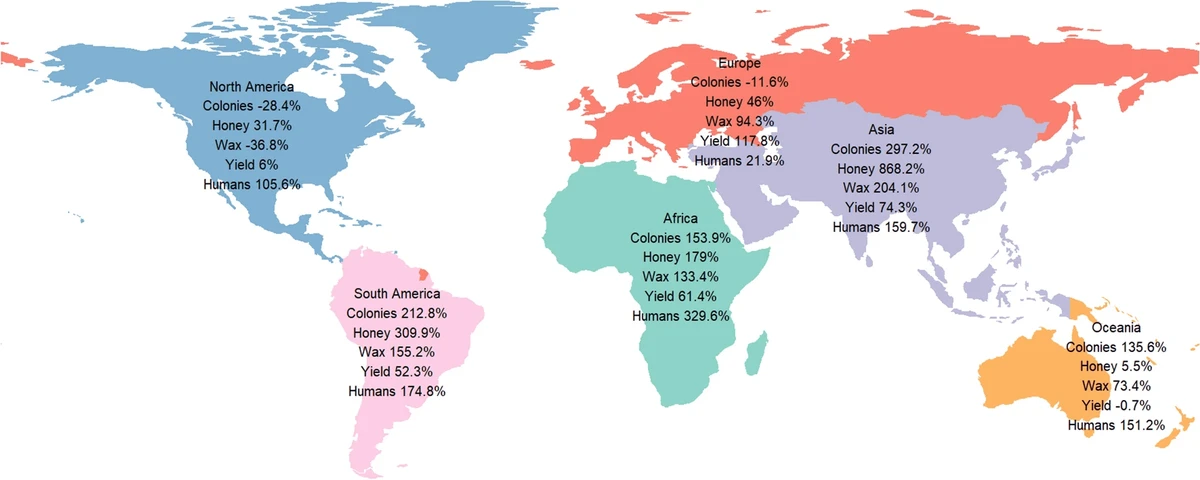
We conducted a retrospective study to examine the long-term trends for the global honey bee population and its two main products: honey and beeswax. Our analysis was based on the data collected by the Food and Agriculture Organization of the United Nations from 1961 to 2017. During this period, there were increases in the number of managed honey bee colonies (85.0%), honey production (181.0%) and beeswax production (116.0%). The amount of honey produced per colony increased by 45.0%, signifying improvements in the efficiency for producing honey.
Concurrently, the human population grew by 144.0%. Whilst the absolute number of managed colonies increased globally, the number per capita declined by 19.9% from 13.6 colonies per 1000 population in 1961 to 10.9 colonies per 1000 population in 2017. Beeswax had a similar trend as the global production per capita reduced by 8.5% from 8.2 to 7.5 kg per 1000 population. In contrast, the global honey production per capita increased by 42.9% at the global level. The global human population growth outpaced that of managed honey bee colonies. Continuation of this trend raises the possibility of having a shortfall of pollinators to meet the increasing consumer demand for pollinated crops. To mitigate these challenges locally driven solutions will be key as influencing factors differed geographically.
Headlines of honey bee colony losses have given an impression of large-scale global decline of the bee population that endangers beekeeping and that the world is on the verge of mass starvation. However, the stories are usually based on research reports limited to one or few countries with observations over a relatively short period of time. A large proportion of cited scientific literature on honey bee mortality originates from Europe and North America, creating some sort of publication bias. Further, the research reports are focused on managed honey bees, Apis mellifera in particular, with little or no information on non-managed bees. Hence, extrapolation of findings from these reports to the global bee population is somewhat inaccurate. Nevertheless, colony losses have been severe during winter in parts of Europe and North America.
At the global level, all the study variables increased between 1961 and 2017. The number of managed honey bee colonies nearly doubled, honey production almost tripled and beeswax production more than doubled. Concurrently, the 2017 human population was more than twice what it was in 1961. The yield of honey per colony increased by about half over the same period.
…
In conclusion, evidence suggests that the number of managed honey bee colonies as well as the production of honey and beeswax globally have increased since the early 1960s. However, the number of colonies and beeswax production per capita declined. This means a larger human population is now reliant on the same the number of honey bee colonies for their services than before. It is likely the dependence will only exacerbate as the level of affluence increases worldwide.
This is an excerpt. Read the original post here
 | Videos | More... |
Video: Nuclear energy will destroy us? Global warming is an existential threat? Chemicals are massacring bees? Donate to the Green Industrial Complex!
 | Bees & Pollinators | More... |
GLP podcast: Science journalism is a mess. Here’s how to fix it

Mosquito massacre: Can we safely tackle malaria with a CRISPR gene drive?

Are we facing an ‘Insect Apocalypse’ caused by ‘intensive, industrial’ farming and agricultural chemicals? The media say yes; Science says ‘no’
 | Infographics | More... |
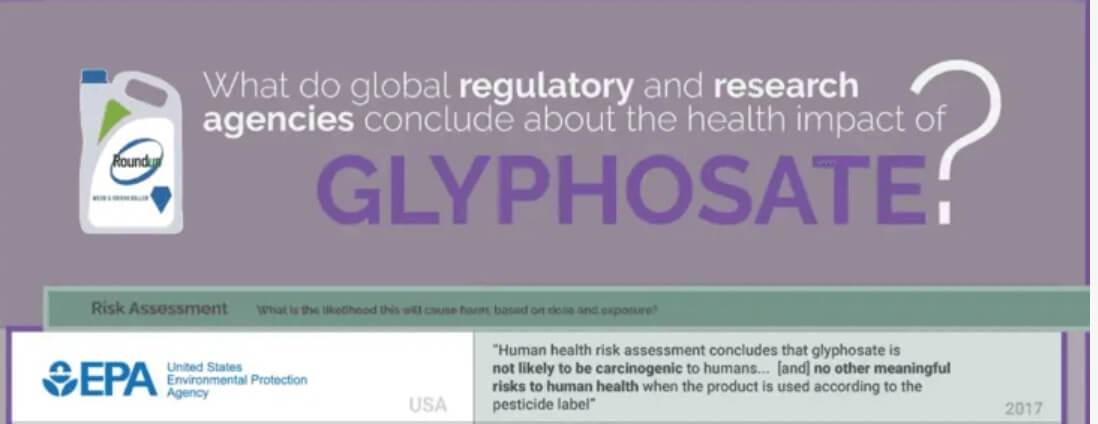
Infographic: Global regulatory and health research agencies on whether glyphosate causes cancer
 | GMO FAQs | More... |

Why is there controversy over GMO foods but not GMO drugs?

How are GMOs labeled around the world?
How does genetic engineering differ from conventional breeding?
 | GLP Profiles | More... |

Alex Jones: Right-wing conspiracy theorist stokes fear of GMOs, pesticides to sell ‘health supplements’

 Viewpoint — Fact checking MAHA mythmakers: How wellness influencers and RFK, Jr. undermine American science and health
 Viewpoint: Video — Big Solar is gobbling up productive agricultural land and hurting farmers yet providing little energy or sustainabilty gains
 Fighting deforestation with CO2: Biotechnology breakthrough creates sustainable palm oil alternative for cosmetics
 Trust issues: What happens when therapists use ChatGPT?
 California, Washington, Oregon forge immunization alliance to safeguard vaccine access against federal undermining
 30-year-old tomato line shows genetic resistance to devastating virus
 The free-range chicken dilemma: Better for birds, but with substantial costs
 ‘You have to treat the brain first’: Rethinking chronic pain with Sanjay Gupta