Deathstroke Is Unforgivable, So Why Does DC Keeps the "Reprehensible" Villain Around?
Trigger Warning: This article discusses New Teen Titans: The Judas Contract, which contains strong implications of an inappropriate relationship between Deathstroke and a minor.
Despite being a fan favorite, Slade “Deathstroke” Wilson is also one of DC’s most controversial characters, infamous for sins that are impossible to ignore. So what makes the elite mercenary so irredeemable? And if fans largely agree that Slade is beyond forgiveness, why does DC keep him around— even going so far as to reframe him as an anti-hero in recent stories?
Created by Marv Wolfman and George Pérez, Deathstroke debuted in The New Teen Titans #2 (1980) and remains best known for his long-running feud with Nightwing and the Teen Titans. Even 45 years after his introduction, he continues to be their greatest adversary, currently serving as the main antagonist in John Layman’s ongoing Titans run—proof of just how enduring this rivalry is.
Over the years, DC has expanded Deathstroke’s role beyond the Titans, giving him solo series and pitting him against a variety of heroes and villains. However, no matter how far he strays, he can never fully escape the Titans, as one of his greatest sins is tied to one of their most iconic storylines—The Judas Contract.
What Makes Deathstroke Such a Controversial Character?
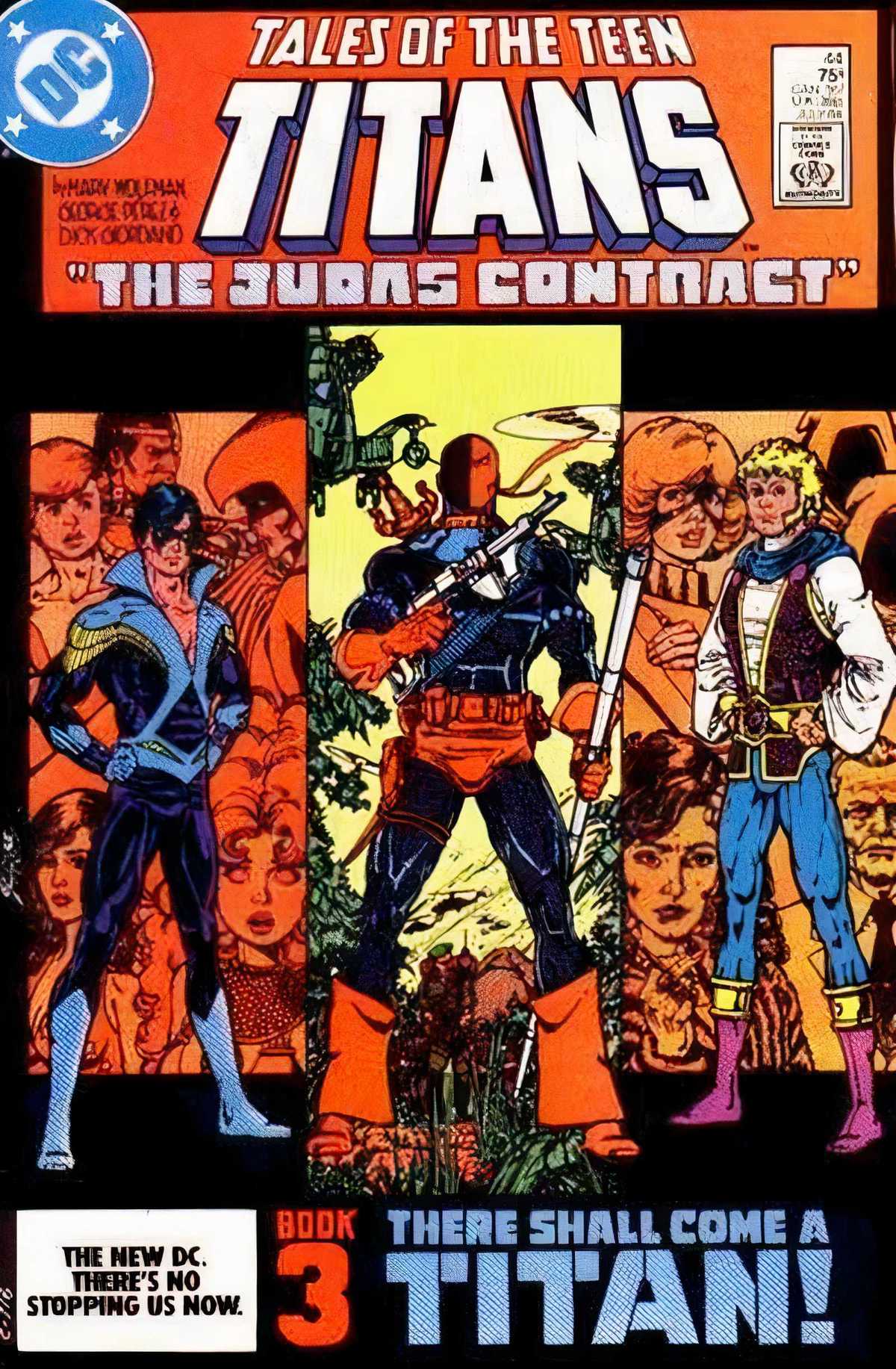
Main Cover by George Pérez for Tales of the Teen Titans #44 (1984)

Even casual fans of Deathstroke and the Teen Titans have likely heard of The Judas Contract. Originally printed in Tales of the Teen Titans #42-44 and concluding in the 1984 Tales of the Teen Titans Annual, this storyline has gone down as one of the most iconic in DC history. However, it is also infamous for the controversial dynamic between Deathstroke and Terra (Tara Markov). In this story, Deathstroke manipulates and exploits Terra, a teenage girl who infiltrates the Titans on his behalf. The comic strongly implies an inappropriate relationship between them, making this aspect of the story highly controversial.
One of the biggest critiques of their dynamic is the stark power imbalance. Terra is portrayed as a naive, vulnerable teenager struggling with her powers and identity, while Deathstroke is a fully formed adult character. As a result, their relationship is widely viewed as predatory, not only due to the manipulation but also because Terra was a minor, making it both immoral and illegal. Later adaptations of The Judas Contract significantly toned down this aspect of the story, but the implications in the original comics remain a major point of debate and criticism. For over four decades, this element of Deathstroke’s past has remained a permanent and unforgivable stain on his character.

10 Darkest DC Comics To Date, Ranked
These stories aren’t for the faint of heart, featuring triggering content and moments of despair that have broken even the strongest heroes.
DC Has Tried to Retcon Events in Deathstroke’s Favor (But It Hasn’t Worked)
Cover B Ivan Tao Variant for Deathstroke Inc. #6 (2022)

DC’s later adaptations of The Judas Contract significantly toned down the portrayal of Slade and Terra’s relationship. The 2017 animated film Teen Titans: The Judas Contract reframed their dynamic, depicting Terra as attempting to seduce Slade, only for him to firmly reject her advances. The original comic storyline was eventually retconned, but because The Judas Contract remains a defining moment for Deathstroke, fans have found it difficult to let this transgression fade from memory. Some also argue that the Shadow War event subtly reintroduced elements of Slade and Terra’s past, implying that their original storyline may still be acknowledged in continuity.
Given The Judas Contract’s significance—not just for Deathstroke, but for the entire DC Universe—and the fact that modern comics continue to reference Slade’s past with the Titans, particularly his interactions with the team when they were teenagers, it has been nearly impossible for the character to escape the "predator" label he earned due to his inappropriate relationship with Terra. Additionally, critics of Slade often cite his “creepy” fixation on Nightwing, particularly during Dick Grayson’s teenage years, further reinforcing allegations that the character exhibits predatory behavior, even beyond The Judas Contract.

9 Things Only Comic Book Fans Know About Nightwing’s Rivalry With Deathstroke
Dick Grayson and Slade Wilson have one of the most infamous rivalries in DC Comics, but their relationship is far more complex than anyone realizes.
“Deathstroke Manipulating a Young Girl Is Reprehensible.” – Christopher Priest on Deathstroke & Tara Markov
Cover B Francesco Mattina Variant for Deathstroke Inc. #1 (2021)

Christopher Priest, the lead writer of the 2016 Rebirth Deathstroke series, has also addressed the controversy surrounding Slade Wilson’s past with Terra. In an interview with Multiversity Comics, Priest responded to fans who criticized his decision to write Deathstroke, with some labeling the character a "p***phile." Priest acknowledged that Slade’s manipulation of Terra was undeniably inappropriate, stating, "Deathstroke manipulating a young girl is reprehensible. It is kind of unsurvivable in terms of character—you really can’t soft-pedal the behavior and continue to root for Deathstroke. Deathstroke’s choices are indefensible."
However, Priest also pushed back against the specific label of "p***phile," arguing that while Slade’s actions were unquestionably wrong, they were rooted in manipulation rather than attraction. He clarified, "A p***phile is a person with a sexual attraction to or predisposition toward children. That’s not Slade Wilson." While this distinction does not absolve Slade’s actions, it framed how Priest approached writing the character, as he did not view him through that particular lens. Hence, this does shed light on how Priest was able to craft such a well-received and fun comic despite working with a character many would claim is irredeemable.
Christopher Preiest: A p***phile is a person with a sexual attraction to or predisposition toward children. That’s not Slade Wilson. If it was, I’d have written the character as a man struggling with those kinds of impulses. I didn’t write him that way because that’s not who the character is. Slade couldn’t stand Terra. He was only using her to help him kill the Titans. Which does not excuse his heinous behavior nor does it, I suppose, fully exempt him from the label.
But labeling him a pedophile diminishes a very serious global threat to children by applying the term generically and often disparagingly as a dismissive aspersion rather than treat the term and condition with the gravity with which it must be considered.
Deathstroke’s Popularity vs. His Past: Why DC Won’t Drop Him
Cover B Ivan Tao Variant for Deathstroke Inc. #7 (2022)

While fans and creators could debate labels for decades (and they have), one thing most can agree on is that there is no excusing Slade’s actions—what he did was morally and legally indefensible. This raises the question: why does DC continue to keep such a reprehensible villain around? The answer is simple—Deathstroke sells. Despite being irredeemable, Slade remains a widely popular character, not because fans excuse his past actions, but because he is exceptionally well-written and compelling. For many who enjoy Deathstroke, it’s his “cool factor” and narrative depth that stand out, rather than The Judas Contract.

Deathstroke Returns to DC Continuity With His Sickest Costume Yet
Deathstroke makes a triumphant return to the DCU—reviving one of his most iconic looks and reclaiming his place as the Titans' ultimate nemesis.
Source: Multiversity Comics