
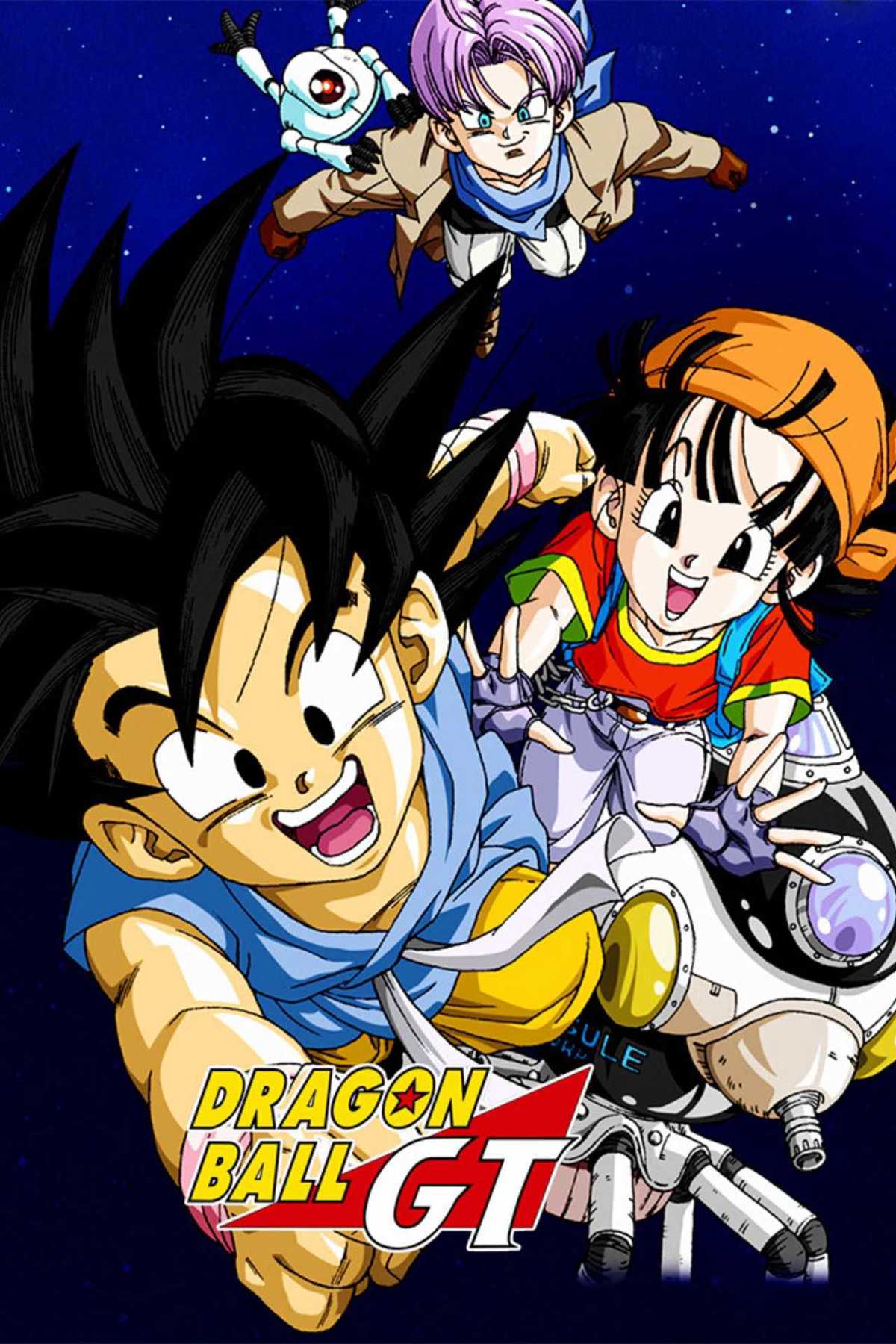
Dragon Ball GT Is a Controversial Anime, But Here's Why Its Most-Hated Arc Is Secretly Genius
It's understandable why so much controversy still surroundsDragon Ball GT to this day, especially its first arc, The Black-Star Dragon Ball Saga. First impressions are very important, and the fact that GT begins by reverting to the more light-hearted feel of the original Dragon Ball series right after the seriousness of DBZ's Buu Saga does itself no favors. The lighter tone coupled with a handful of episodes that don't contribute much to the overall plot left many Dragon Ball fans feeling sour about GT's first arc.
However, the Black-Star Dragon Ball Saga has many successes worth celebrating. The saga's overall concept is genius. Not only does the opening arc bring the original series' focus on Dragon Balls to the next logical step by launching them into space, but GT expands upon their lore in ways that Super and Daima haven't. The latter two series introduce new Dragon Balls, while GT delves deeper into the magical artifacts at the series' heart. While fans may have many valid complaints, a closer examination reveals that the Black-Star Dragon Ball Saga actually has more than a few bright spots.
7 Dragon Ball GT Innovates on the Formula Established By the Original Series
There's Not a Dragon Ball on Every Planet
Although the concept of the Dragon Balls getting scattered across numerous planets is a logical progression for Dragon Ball, GT could have succumbed to a common problem in adventure anime when the main goal is to obtain objects, and then every place the hero goes leads to the object being found. In GT, Goku and company visit various planets in the galaxy to find the Dragon Balls, so the series could have easily put a Dragon Ball on every planet they visit.
But this doesn't happen in GT. In fact, the very first planet they visit - planet Imecka - doesn't have a Dragon Ball. They didn't even mean to go there. They crash-landed. Instead, GT treats Imecka as a random incident that culminates in them finding and recruiting the robot Giru, who plays a critical role later on. Ironically, GT initially presented the opportunity to justify their finding a Dragon Ball on Imecka when Trunks said it would be too much of a coincidence if this happened on a planet they visited by accident.
Serendipity is a common plot point in adventure stories. Everything doesn't have to happen for a reason and part of the fun of adventure stories is visiting new places with a cast of likable characters. While contributing to an overarching plot is nice, it isn't always necessary. GT realizes this with the Dragon Balls, and continues this pattern with planet M-2 and Pital. It's remarkable that GT breaks this fairly common formula immediately rather than build up to it later.
6 The Black-Star Saga Complicates Finding the Dragon Balls
Goku's Personality and Flaws Actually Play a Role in Finding the Dragon Balls
Even though planet-hopping for Earth Dragon Balls was completely new at the time, the mechanics of how Goku and company would find the Dragon Balls could still have been the same, especially since the original series ostensibly had already exhausted every variable. In fact, there are many scenarios that GT replicates. Probably the most obvious instance of this occurs in the episode "Trunks, the Bride," when Trunks has to dress up as a monster's bride since Goku did the same to protect a girl from the monster Oolong. Goku even directly references the moment.
But on planet Monmaasu, GT introduces a new formula. It becomes the first time in the franchise that a downside of Goku's personality complicates the collection of a Dragon Ball. The Dragon Ball they needed to obtain was just sitting in the middle of an open field, and Trunks immediately spots it and goes to pick it up. But Goku, who is busy eating a giant apple in a tree, drops the fruit on top of the Dragon Ball, which then sets off a series of unfortunate events.
5 The Black-Star Saga Is More Complex Than Most Fans Realize
The Saga Isn't Just About Going From Point A to Point B
Ironically, one of the more common methods of collecting Dragon Balls that GT does borrow from the original series proves the sequel's complexity. It begins with a Dragon Ball getting stolen. This has happened to Goku more than once in the franchise, and in GT, the Para Para Brothers are the next culprits. It would have been understandable if part of the fandom's outrage over GT was if the chase after the Para Para Brothers was from planet Tigere to planet Luud.
Instead, the Para Para Brothers first get Goku and company stranded inside an asteroid and then return to planet Luud without their pursuers, only for them to be sent back to retrieve the other Dragon Ball from them. Upon their return, the Para Para Brothers battle Goku and company before returning to planet Luud together. These extra developments allow the series to build greater anticipation for planet Luud, where Goku and company were destined to visit, and, more importantly, the mysterious Lord Luud.
In another instance, GT uses a great deal of embellishing to complicate one of the series' shortest visits to a planet in a way that highlights GT's more complex storytelling despite being presented in a small package. Goku's time on planet Monmaasu only lasts one episode, but GT's creators split Pan from Trunks and Goku to create two separate, but very creative, stories that are based upon the planet's larger inhabitants. These two stories then collide satisfactorily with Goku and Trunks inadvertently solving Pan's unique dilemma.
4 The Black-Star Saga Has Dragon Ball's Smoothest Transition Between Arcs
The Black-Star Saga Leads Naturally Into the Baby Saga
Save for the first two sagas of Z, the majority of Dragon Ball's sagas are distinct from each other. Many of them are even separated by years. As a whole, each GT saga actually transitions immediately the next, making the series far more cohesive. The Black-Star Dragon Ball Saga sets up the connective tissue for the Baby Saga, blending together seamlessly. Baby starts attacking and taking over the inhabitants on Earth before Goku and company finish searching for the remaining Black-Star Dragon Balls.
In addition to adding some diversity and nuance to the pacing of Dragon Ball GT, this more natural transition allows the first saga to get away with not having to provide complex scenarios for every Dragon Ball search. During this time, the remaining Dragon Balls Goku and company find are fairly simple, and the series gets away with this because they're offset by the drama unfolding on Earth.
An argument can be made that a good form of storytelling involves slowly building up to more complex plot lines, but that isn't always the most realistic approach. The saga slips in simpler Dragon Ball searches between more complex scenarios even before the beginning of the Baby Saga, including Goku, Trunks, and Pan's time on planet Rudeeze, which only lasts one episode.
3 The Black-Star Saga Features One of Dragon Ball's Most Dynamic Relationships
Pan and Giru Are Two Great Characters
The events on Rudeeze also serve a more important purpose than breaking up the complexity of each planet. It presents a major turning point in GT's most stunning relationship, the one between Pan and Giru. While there are many relationships that change dramatically throughout Dragon Ball (which is why Goku has so many potential best friends), the one between Pan and Giru is noteworthy since it evolves so quickly but still convincingly. Most other famous relationships in the series take numerous sagas before any major change occurs.
At the start of GT, Pan doesn't like Giru, and a generous amount of the series' comedic routines involve her terrorizing the poor robot. But there are two major shifts that occur in their relationship that happen in quick succession, and it's the quickness of these events that makes them so effective. Pan's outlook on Giru changes during that momentous episode on planet Rudeeze when the robot saves her from death, which leads to her completing their mission on the planet and thus convincing Goku and Trunks, who were thinking about kicking her off the team, to keep her.
The irony is that, immediately when Pan becomes affectionate toward Giru, the group is led to mistakenly believe that he has betrayed them. This development angers Pan because she had just accepted him as a friend one episode earlier. If she had stuck with her gut reaction, then she wouldn't have been stung so hard. This twist of fate causes her later interactions with Giru to be especially tense, which only heightens the drama. Of course, when Giru's true loyalty comes to light, his reunion with Pan is all the more satisfying.
2 The Black-Star Saga is Full of Foreshadowing
GT Excells At Hinting At Later Plot Developments
While foreshadowing is an important element of most stories, it's something Dragon Ball typically doesn't dabble in too much. Surprisingly, GT successfully uses foreshadowing on a major scale. It begins with Giru on the planet that is easy to write off in the grand scheme of things - Imecka. Giru doesn't just become a main character in Goku's traveling party. He ends up being connected to the saga's big bad, who isn't even introduced until much later - Dr. Myuu.
Although Dr. Myuu is headquartered on the planet M-2, he isn't introduced there when Goku and company finally arrive. A more two-dimensional form of storytelling without any foreshadowing would have made that very much the case. Instead, he makes many brief appearances before then. His debut was as the true mastermind on planet Luud. In fact, fans were tricked twice on who planet Luud's true villain was. First, it was Mutchy Mutchy before Dolltaki's appearance, who momentarily takes his place before Dr. Myuu's big introduction. It isn't until much later that Dr. Myuu's significance to the saga is truly realized.
1 The Black-Star Saga Contains Dragon Ball's Most Twisted Villain
There's no one else like Dolltaki
Dragon Ball has always had the problem of making its minor villains stand out from its major antagonists. In GT, Dolltaki can very easily be interpreted as just a secondary character based on his aforementioned momentary cameo between Mutchy Mutchy and Dr. Myuu. While only relevant for a short time, Dolltaki reveals himself to be one of the most twisted villains that Dragon Ball has ever had.
What makes this more impressive is that Dolltaki is relatively weak compared to the franchise's usual threats. While this adds some much-needed diversity to Dragon Ball's roster of rogues, what stands out is why he's twisted. It's not just his awkward obsession with playing dollhouse as a grown adult, but how he obsesses over Pan after transforming her into his newest doll. The look on his face as he was about to remove some of her clothing is horrific on a level that goes beyond most Dragon Ball villains.
Despite its many strong points, it's understandable why fans would have such a problem with the Black-Star Saga and GT in general. Tone understandably plays a major role or is the definitive factor as to why many fans enjoys or dislike specific anime, and the Black-Star Saga definitely diverges from the seriousness of Dragon Ball Z.
Even though Dragon Ball Z still incorporates some goofier moments, it's significantly less than what fans initially saw in GT. The tone of the Black-Star Dragon Ball Saga might also be more faithful to the overall atmosphere of the original Dragon Ball, but the fact that it takes place after Dragon Ball Z can make it a tough pill to swallow for fans who were mostly unaware of the series' origins. Still, if fans are willing to give it a chance and meet it at its level, there's more than a little bit of good in Dragon Ball GT'sBlack-Star Saga.

Dragon Ball GT
- Release Date
- 1997 - 1997-00-00
- Network
- Fuji TV
- Showrunner
- Akira Toriyama
- Directors
- Minoru Okazaki, Mitsuo Hashimoto, Yoshihiro Ueda, Takahiro Imamura, Hidehiko Kadota, Osamu Kasai, Hiroyuki Kakudou, Shigeyasu Yamauchi
- Writers
- Akira Toriyama
Cast
 Masako NozawaOob (voice)
- Yûko MinaguchiUncredited
Dragon Ball GT is the third series in Akira Toriyama's most famous anime franchise. However, it is the first one not to adapt a manga storyline. Set after the events of the Buu Saga, Dragon Ball GT sees Goku and the Z-Warriors battle powerful villains such as Baby, Super 17, and the Shadow Dragons. 18 years after the 64-episode show was met with a lukewarm reception, Dragon Ball Super replaced it in the anime's official continuity.
- Franchise(s)
- Dragon Ball
- Producers
- Kōzō Morishita
- Seasons
- 1
- Story By
- akira toriyama
- Streaming Service(s)
- Hulu







Your comment has not been saved