Enhanced Charge Transfer and Photoelectric Response Through Lattice Atom-Bridge Chemical Bond Interfaces
Enhanced Charge Transfer and Photoelectric Response Through Lattice Atom-Bridge Chemical Bond Interfaces
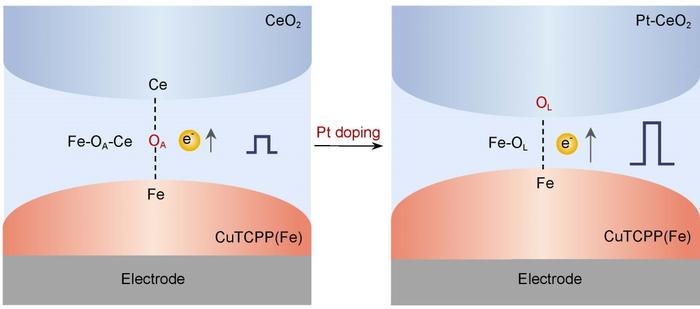
The recent advancement in photoelectrochemical (PEC) systems has opened new avenues for not only energy conversion technologies but also biomedical applications, particularly in the realm of biosensing. A research team has made significant strides by constructing an innovative p-n junction that utilizes atomic-level platinum (Pt) doping in cerium oxide (CeO2) coupled with two-dimensional (2D) metalloporphyrin metal-organic framework nanosheets. This novel structure, referred to as Pt-CeO2/CuTCPP(Fe), has been shown to enhance the overall PEC performance remarkably.
One of the key highlights of this research is the meticulous induction of atomic-level Pt doping in CeO2. This modification is not a mere enhancement; instead, it fundamentally alters the chemical dynamics at the interface. By facilitating a transition from retained adsorbed oxygen (Fe-OA) to lattice oxygen (Fe-OL), the team has decreased the carrier transport distance. Such a reduction plays a pivotal role in optimizing charge transfer efficiency. Indeed, the study notes an astonishing 2.5-fold enhancement in photoelectric performance when compared to traditional CeO2/CuTCPP(Fe) structures, marking a significant breakthrough in the mechanics of PEC systems.
Further analysis showcased that the introduction of atomic-level Pt not only increased the density of oxygen vacancies but also instigated lattice perturbations. This intrigue is not merely an academic exercise; it has practical implications. By facilitating the transition from Fe-OA to Fe-OL, the material’s ability to facilitate charge transport has been critically improved. As one delves deeper into the mechanics of this enhanced performance, it becomes abundantly clear that this level of atomic precision in doping allows for exceptionally low energy barriers for charge transfer.
Moreover, this innovative junction has illustrated an extraordinary capability in a specific application: biosensing. Utilizing the peroxidase-like activity of the Pt-CeO2/CuTCPP(Fe) junction, the research team has rolled out a highly sensitive immunoassay targeting prostate-specific antigens. This assay is noteworthy, achieving a detection limit that approaches an impressive 0.71 pg mL-1. Developing such high-sensitivity detection methods underscores the junction’s potential, furthering its applicability beyond merely enhancing PEC systems to becoming a cornerstone in clinical diagnostics.
The implications of these findings resonate beyond theoretical realms and venture into transformative applications in clinical settings. The ability to construct advanced heterojunction interfaces armed with optimized charge transfer pathways can significantly streamline the evolution of high-performance PEC sensors. This research elucidates the complex interplay between interfacial chemical bonds and photoelectric performance, setting the stage for future innovations that will undoubtedly push the boundaries of current biosensing capabilities.
The insightful exploration conducted by the team has broader implications for materials science and engineering. With academic rigor and practical foresight, they have created an avenue that invites further research into the intricacies of material interfaces and their subsequent performance in PEC applications. Each finding weaves a narrative that not only advances our understanding but also builds a foundation for others to innovate upon, prompting a legacy of research that promises further discoveries.
Moreover, such strategically designed interfaces underline the importance of ongoing collaboration within multidisciplinary domains—combining chemistry, nanotechnology, and engineering to yield transformative scientific advancements. The potential for real-world applications—encompassing environmental sensing, medical diagnostics, and more sustainable energy systems—demonstrates how such research is not restricted to isolated benefits but contributes broadly to societal needs.
In summary, the study marks a significant leap in the field of PEC performance through refined atomic-level doping techniques. By bridging multiple scientific disciplines, this research reveals insights that could eventually lead to transformative applications in healthcare and beyond. The remarkable performance enhancements seen in the Pt-CeO2/CuTCPP(Fe) system hint at an exciting future where advanced materials play an integral role in evolving technologies.
The route taken by the research team is a compelling narrative of how science can effect change. It illustrates that meticulous engineering at the atomic level can lead to groundbreaking applications and enhances our understanding of material behaviors in responsive environments. As we look ahead, this research not only charted a new course in PEC performance but also illuminated a path for future exploration in intertwined scientific fields.
Lastly, as with all impactful science, it beckons an inquisitive mind to ponder the next frontier awaiting our exploration. What next will be discovered through the marriage of chemistry and physics, as seen in successful experiments like these? The excitement and potential within this space remain palpable, extending a call to action for future scientists and researchers to continue this journey.
Subject of Research: Atomic-level Pt Doping for Optimized Photoelectrochemical Performance
Article Title: Advances in Photoelectrochemical Systems: Atomic-Level Platinum Doping in Cerium Oxide
News Publication Date: [Insert Date]
Web References: [Insert relevant links]
References: [Insert published papers and studies]
Image Credits: ©Science China Press
Keywords
Photoelectrochemical systems, atomic-level doping, biosensing, cerium oxide, platinum, interfacial bonding, charge transfer efficiency, prostate-specific antigens, nanosheets, innovative materials.
BGI Genomics’ Joint Venture Genalive Lands ¥950 Million RMB Genetic Testing Contract in Saudi Arabia
Next PostNWPU Unveils Engineered Platelet-Based Nano-Aircraft for Targeted Tumor Chemoimmunotherapy and Precision Drug Delivery
Related Posts

Random-Event Clocks Offer New Window into the Universe’s Quantum Nature
Scientists reinvigorate pinhole camera technology for advanced next-generation infrared imaging
Portable Light-Based Brain Monitor Demonstrates Potential for Advancing Dementia Diagnosis
BeAble Capital Invests in UJI Spin-Off Molecular Sustainable Solutions to Advance Disinfection and Sterilization Technologies
Scientists Pioneer Innovative Method for Precise Experimental Measurement of the Unruh Effect