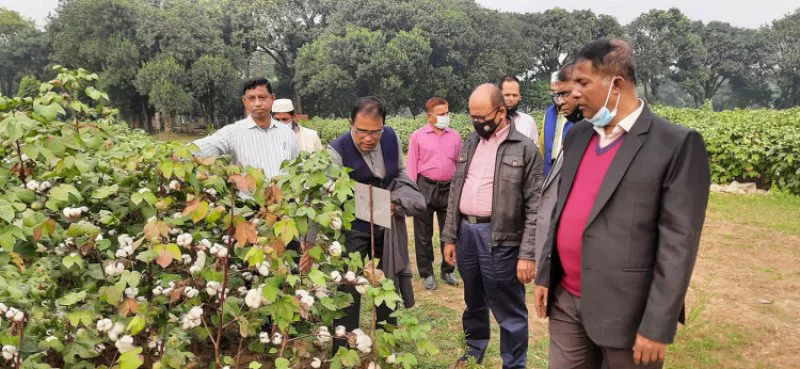
With Bangladesh likely to approve commercial cultivation of genetically modified (GM) Bt cotton varieties sourced from an Indian company soon, seed manufacturers in the country have urged for regulatory approval of the new generation of herbicide-tolerant Bt (HTBt) cotton varieties whose application is pending with Genetic Engineering Appraisal Committee (GEAC).
According to Ram Kaundinya, director general, Federation of Seed Industry for India, the government has to go ahead with deployment of modern GM technology urgently to cut down on rising cost of pesticides and labour in cotton cultivation.
…
“Bangladesh’s preference of Indian Bt technology in the past should be a wake up call for the environment ministry to seriously evaluate pending biotechnological applications and facilitate the process of approval of next generation Bt technologies,” Bhagirath Choudhary, founder director, South Asia Biotechnology Centre, said.
Since its introduction two decades ago, Bt cotton has led to a dramatic rise in India’s cotton yield and thereby, production, but over the last two-three years, the yield has come down marginally. The cotton production rose from 8.62 million bales (of 170 kg each) in 2002-03 to 34.04 MB in 2021-22.
Once introduced for commercial cultivation, Bt cotton will be Bangladesh’s second GM crop after Bt brinjal which was approved in 2013. The report stated that by introducing high-yielding and pest-resistant Bt cotton in 2002, India made a complete turnaround from a cotton importing country to an exporting country. “Over the past two decades, India has emerged as the world’s number one exporter of cotton and also commands nearly a third of Bangladesh’s total import volume of the natural fibre,”it stated.

















 Viewpoint — Fact checking MAHA mythmakers: How wellness influencers and RFK, Jr. undermine American science and health
 Viewpoint: Video — Big Solar is gobbling up productive agricultural land and hurting farmers yet providing little energy or sustainabilty gains
 Fighting deforestation with CO2: Biotechnology breakthrough creates sustainable palm oil alternative for cosmetics
 Trust issues: What happens when therapists use ChatGPT?
 California, Washington, Oregon forge immunization alliance to safeguard vaccine access against federal undermining
 30-year-old tomato line shows genetic resistance to devastating virus
 The free-range chicken dilemma: Better for birds, but with substantial costs
 ‘You have to treat the brain first’: Rethinking chronic pain with Sanjay Gupta