How to scale up lab-grown meat? Scientists ‘zap animal cells with a magnet’


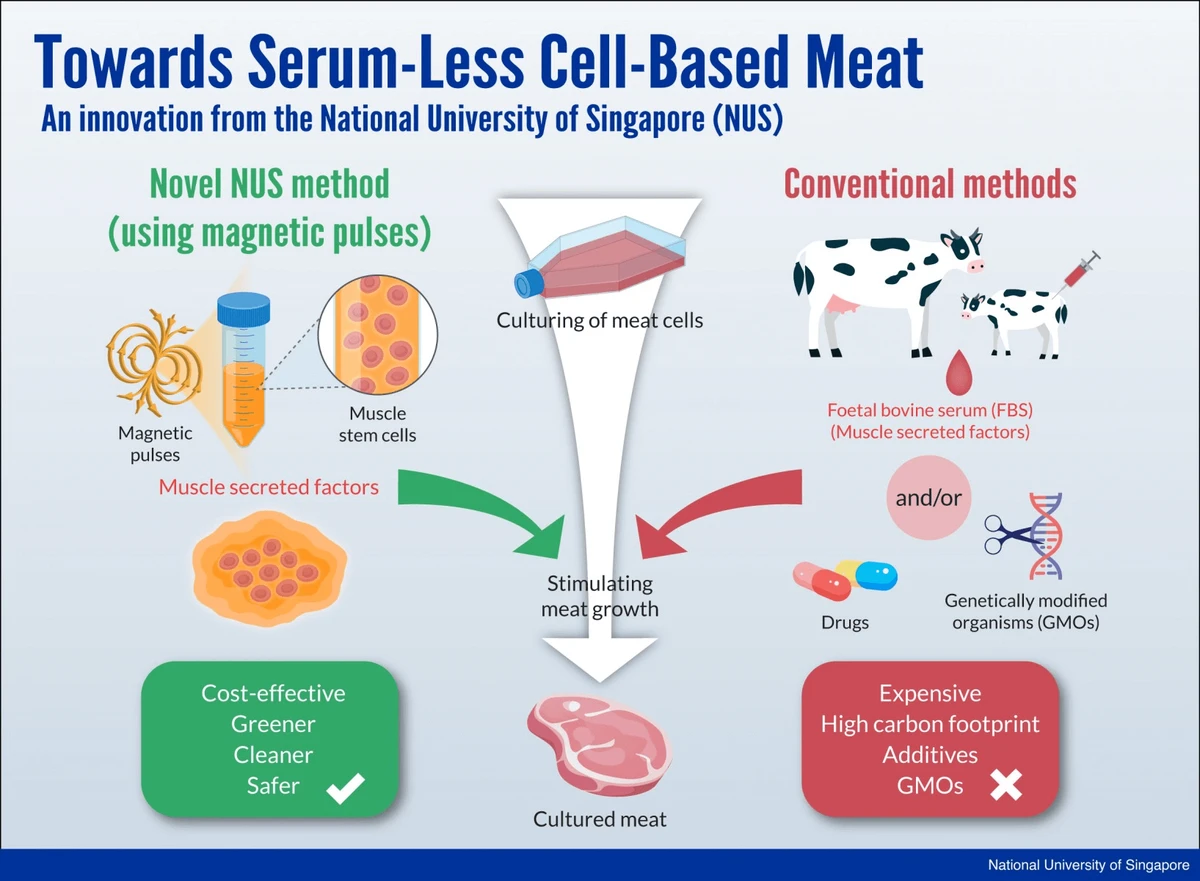
Cultured meat is an alternative to animal farming with advantages such as reducing carbon footprint and the risk of transmitting diseases in animals. However, the current method of producing cultured meat involves using other animal products, which largely defeats the purpose, or drugs to stimulate the growth of the meat.
To cultivate cell-based meat, animal cells are fed animal serum – usually foetal bovine serum (FBS), which is a mixture harvested from the blood of foetuses excised from pregnant cows slaughtered in the dairy or meat industries – to help them grow and proliferate. This is a critical, yet cruel and expensive, step in the current cell-based meat production process. Ironically, many of these molecules come from the muscles within the slaughtered animal, but scientists did not know how to stimulate their release in production scale bioreactors. Other methods to promote cell growth are using drugs or relying on genetic engineering.

The complex production process for cell-based meat increases cost, limits the manufacturing scale and undermines the commercial viability of cell-based meat.
To help address this challenge, a multidisciplinary research team led by Associate Professor Alfredo Franco-Obregón, who is from the NUS Institute for Health Innovation & Technology and the NUS Yong Loo Lin School of Medicine, came up with an unconventional method of using magnetic pulses to stimulate the growth of cell-based meat.
Growing cell-based meat with the help of a magnet
The NUS technique uses a delicately tuned pulsed magnetic field developed by the team to culture myogenic stem cells, which are found in skeletal muscle and bone marrow tissue.
Assoc Prof Franco-Obregón explained, “In response to a short 10-minute exposure to the magnetic fields, the cells release a myriad of molecules that have regenerative, metabolic, anti-inflammatory and immunity-boosting properties. These substances are part of what is known as the muscle “secretome” (for secreted factors) and are necessary for the growth, survival and development of cells into tissues. We are very excited about the possibility that magnetically-stimulated secretome release may one day replace the need for FBS in the production of cultured meat.”
He added, “The growth-inducing secretomes can be harvested in the lab safely and conveniently, and also at low cost. This way, the myogenic stem cells will act as a sustainable and green bioreactor to produce the nutrients-rich secretomes for growing cell-based meat at scale for consumption. The muscle knows how to produce what it needs to grow and develop – it simply needs a little bit of encouragement when it is outside its owner. This is what our magnetic fields can provide.”
Applications in regenerative medicine
The harvested secretomes can also be used for regenerative medicine. The NUS team used the secreted proteins to treat unhealthy cells and found that they help to accelerate the recovery and growth of the unhealthy cells. Therefore, this method can potentially help to cure injured cells and speed up a patient’s recovery.
The research team published their findings in the August 2022 issue of the scientific journal Biomaterials. A patent has also been filed for this novel technology and the NUS team is currently in active discussions with potential industry partners to commercialise the technology.
Read the original post here

 | Videos | More... |
Video: Nuclear energy will destroy us? Global warming is an existential threat? Chemicals are massacring bees? Donate to the Green Industrial Complex!
 | Bees & Pollinators | More... |

GLP podcast: Science journalism is a mess. Here’s how to fix it

Mosquito massacre: Can we safely tackle malaria with a CRISPR gene drive?

Are we facing an ‘Insect Apocalypse’ caused by ‘intensive, industrial’ farming and agricultural chemicals? The media say yes; Science says ‘no’
 | Infographics | More... |

Infographic: Global regulatory and health research agencies on whether glyphosate causes cancer
 | GMO FAQs | More... |

Why is there controversy over GMO foods but not GMO drugs?

How are GMOs labeled around the world?
How does genetic engineering differ from conventional breeding?
 | GLP Profiles | More... |

Alex Jones: Right-wing conspiracy theorist stokes fear of GMOs, pesticides to sell ‘health supplements’

 Viewpoint — Fact checking MAHA mythmakers: How wellness influencers and RFK, Jr. undermine American science and health
 Viewpoint: Video — Big Solar is gobbling up productive agricultural land and hurting farmers yet providing little energy or sustainabilty gains
 Fighting deforestation with CO2: Biotechnology breakthrough creates sustainable palm oil alternative for cosmetics
 Trust issues: What happens when therapists use ChatGPT?
 California, Washington, Oregon forge immunization alliance to safeguard vaccine access against federal undermining
 30-year-old tomato line shows genetic resistance to devastating virus
 The free-range chicken dilemma: Better for birds, but with substantial costs
 ‘You have to treat the brain first’: Rethinking chronic pain with Sanjay Gupta