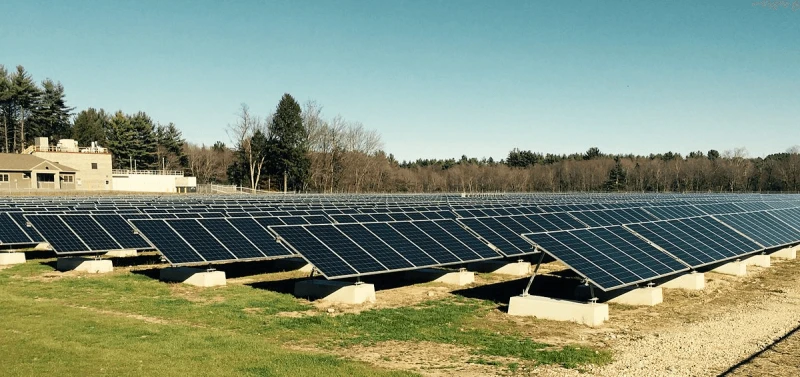
Farms have a lot of open land and that has made them ideal for solar power installations. For example, though it is in defiance of the bucolic imagery sold by food and solar marketing groups, which show lush farms with an old tractor on one side and panels on homes charging an $80,000 Tesla on the other, New York has large-scale solar installations on 40 percent of their farms while up to 84 percent of farms will be great for solar.
Not just because of open land but because farms make solar more efficient also.
A study shows that solar panels mounted over a soybean crop had temperature reductions of nearly 50 degrees Fahrenheit over bare land. Cooler temperatures mean longer solar panel lifespan and that is going to matter if solar power will ever work without a government-forced revenue cushion. This flies in the face of claims that alternative energy and food are in competition with each other. Instead, the fluid dynamics model found that the panels did better over vegetation than bare land – and of course environmentalists oppose solar panels on America’s conservation land so farms fit nicely.
It’s also good for farmers, who have to operate on razor-thin margins in food whereas solar panels are mandated and thus generously subsidized by the government – the high costs are passed along to the other 99 percent of the US. It would even be a win for science literacy and acceptance by the public because a giant chunk of the crops grown on those farms that are providing solar power are GMOs – settled science that environmentalists still oppose.
The organic process lauded by anti-science activists uses too many chemicals on too much land, whereas modern farming that can double up for food and solar will also leave more open space for conservation, a trend that modern farming has already made possible.
Given the size of the average farm in the US, and a megawatt of solar produced per every 5 acres on a good day, a farms doubling as a solar plant could power 18,000 homes. The largest solar installation in the world still only powers 150,000 homes but 2,000,000 American farms producing energy for 18,000 residences and food would have a giant impact, power literally every home in the world 18 times over. If those farms use modern crop protection tools then land use is even more optimal.
It will be a challenge for environmentalists to continue their war on agriculture when farmers show pictures of giant utility-sized solar installations stopping global warming – and that is good for the public trust in science we want in a post-COVID world.
Such agrivoltaic systems are in use now but getting little cultural awareness. If they approach 80 percent it will be an environmental marketing dud to demonize farms and since science denial is often in camps, acceptance of energy would also mean acceptance of food science and vaccines and other medicines.
“We’re showing dual benefits,” says Cornell graduate student and lead author Henry Williams. “On one hand, you have food production for farmers, and on the other hand, we’ve shown improved longevity and improved conversion efficiency for solar developers.”
Those are both wins if we want to keep food affordable while having solar make any meaningful inroads for energy without spending another $4 trillion to prop it up.
Hank Campbell founded Science 2.0 in 2006, and writes for USA Today, Wall Street Journal, CNN, and more. His first book, Science Left Behind, was the #1 bestseller on Amazon for environmental policy books. Follow Hank on Twitter @HankCampbell
A version of this article was originally posted at Science 2.0 and has been reposted here with permission. Any reposting should credit the original author and provide links to both the GLP and the original article. Find Science 2.0 on Twitter @science2_0












 Viewpoint — Fact checking MAHA mythmakers: How wellness influencers and RFK, Jr. undermine American science and health
 Viewpoint: Video — Big Solar is gobbling up productive agricultural land and hurting farmers yet providing little energy or sustainabilty gains
 Fighting deforestation with CO2: Biotechnology breakthrough creates sustainable palm oil alternative for cosmetics
 Trust issues: What happens when therapists use ChatGPT?
 California, Washington, Oregon forge immunization alliance to safeguard vaccine access against federal undermining
 30-year-old tomato line shows genetic resistance to devastating virus
 The free-range chicken dilemma: Better for birds, but with substantial costs
 ‘You have to treat the brain first’: Rethinking chronic pain with Sanjay Gupta