Is This the Best Bang-for-Buck Backpacking Trip in Alaska?
Is This the Best Bang-for-Buck Backpacking Trip in Alaska?
Two born-and-raised Alaskans think the Bomber Traverse might be one of the best wilderness backpacking trips in the U.S. However, even experienced backpackers must be prepared for challenging conditions, including glacier travel, scrambling through boulder fields, and even midsummer snowfall.
Heading out the door? Read this article on the new Outside+ app available now on iOS devices for members! Download the app.
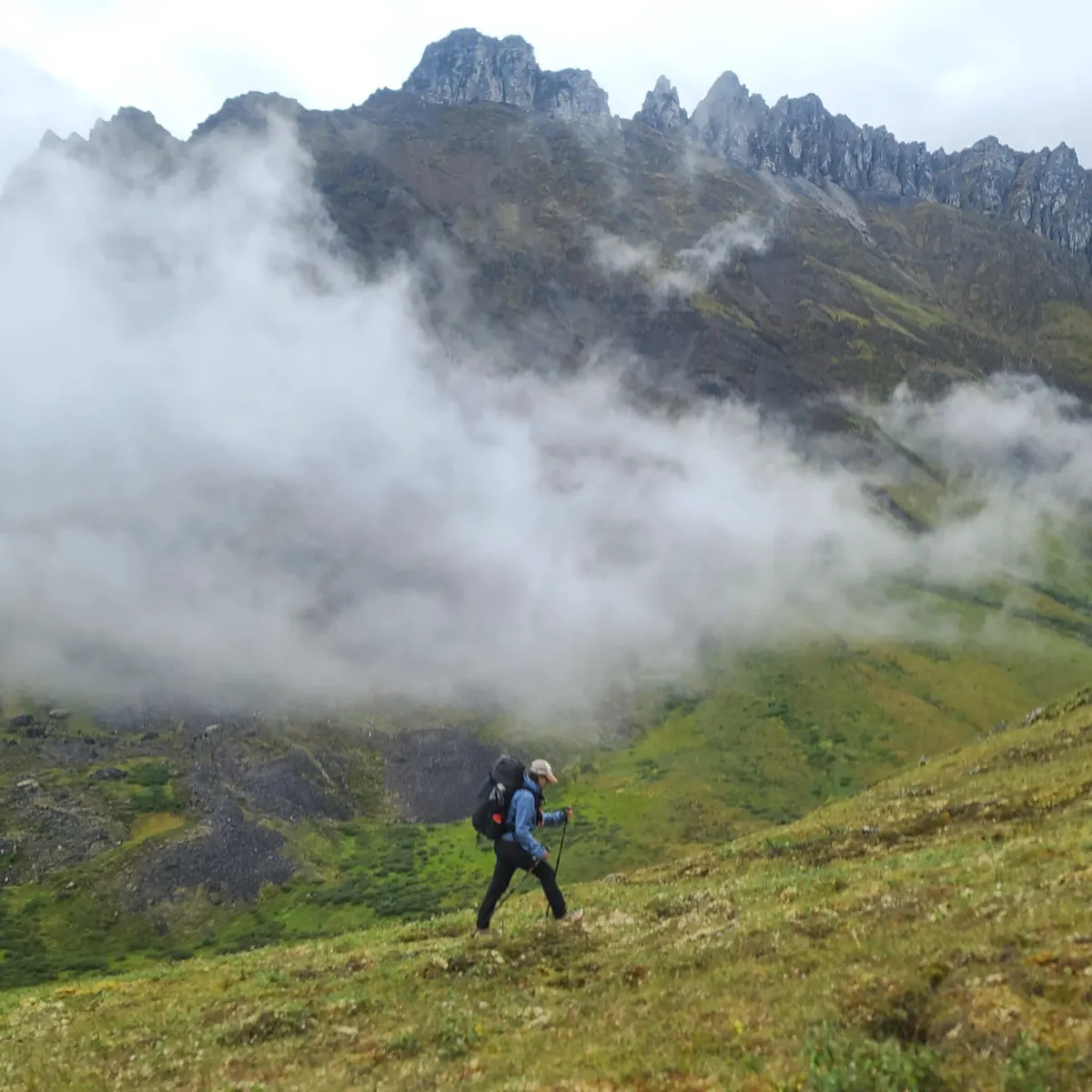
Our boots leave the only visible tracks on the green shale and granite as we near the sun-washed summit of Rainy Day Knoll in the Talkeetna Mountains of Alaska. We are on a side hike off the Bomber Traverse, a popular hut-to-hut backcountry backpacking route, but the higher we climb, the more this humbly-named point feels like the main event. Far below us, Bartholf Creek winds through lush foliage toward the Kashwitna River. Above the valley floor, the mountainsides quickly transition to yellow and green tundra and then just as quickly to a maze of serrated black peaks separated by the remnants of dying glaciers. It is equal parts Sound of Music and Lord of the Rings, and yet also quintessentially, spectacularly Alaska.
From the top of Rainy Day Knoll, we can make out the Snowbird, Bomber, and Pennyroyal glaciers, all of which are crossed by those completing variations on the Bomber Traverse. In its “standard” form, the horseshoe-shaped Bomber Traverse includes overnight stays at three volunteer-run, first-come-first-served wilderness huts. The route also travels over two high passes and at least two glaciers, but you can also “choose your own adventure” through these mountains, taking advantage of any of five huts in the area and nearly limitless routes between them.
Those who plan trips here should be forewarned, however: despite the relatively short distances between the huts, the Talkeetnas are a true alpine backcountry area. The trail can disappear into a morass of tundra or end abruptly at the edge of a snowfield or raging glacial creek, and the passes are tall enough to make you feel like you’re in the front row of a movie theater. Boulders teeter precariously in the passes and on craggy peaks, and can rock ominously with even a light touch. At only 40 million years old, these are young mountains compared to, say, the Rockies (which formed 55-80 million years ago) or the Blue Ridge Mountains (1.2 billion years), and they act their age; this landscape is vibrant and full of energy, but also chaotic, unsettled, and restless. Backpackers must also note that there are no navigational signs along the Bomber Traverse. The route, however, is generally straightforward for those who are well-versed in backcountry navigation.
The glacial remnants on the Bomber Traverse are what’s left of vast fields of ice that once carved the range’s dramatic cliffs, spires, and valleys. Yet even these small glaciers demand respect: Take caution to avoid moulins (natural wells where surface water works its way into a glacier, sometimes traveling vertically for hundreds of feet), S-shaped “wiggles” of surface melt, and the occasional randkluft (crevasse-like features that form when glaciers melt away from rock headwalls).
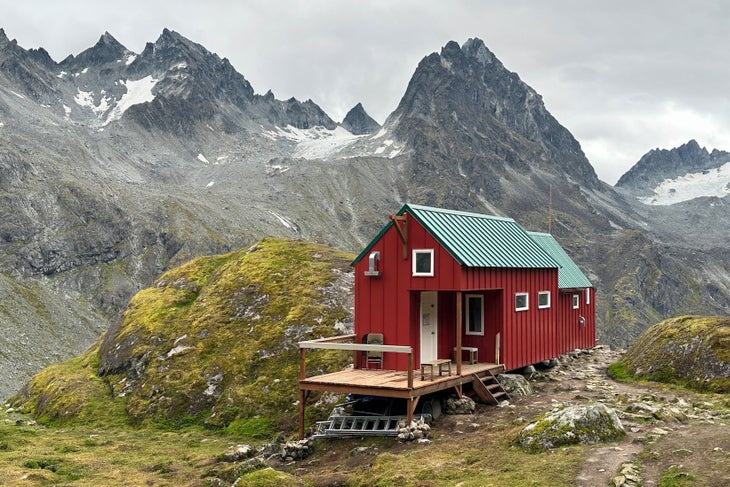
Day 1: Gold Mint Trailhead to Mint Hut
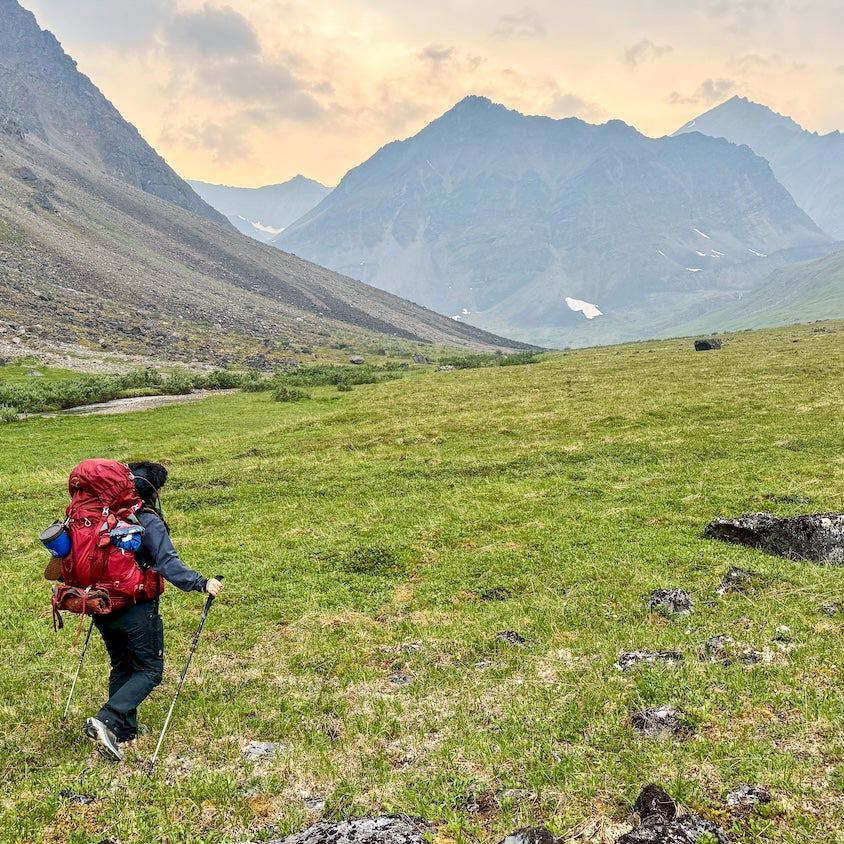
Start your Bomber Traverse adventure with an 8.5-mile trek from the Gold Mint Trailhead to the Rainery Hut (commonly called the Mint Hut today). The first 7 miles are gentle, and you can sink into a rhythm. The well-trodden path gently ascends alongside the waters of the Little Susitna River as the route weaves in and out of thickets and offers sweeping views of snow-dusted peaks that loom in every direction. End the day with a 1.5-mile scramble (mostly class 1 with the occasional class 2 section) to the hut, a cherry-red structure perched on the edge of a cliffy bench. For those with gas left in the tank, take a 1.5-mile (round trip) side hike to Jewel, Moonstone, Beryl, and Ivory lakes, which range in color from opaque turquoise to green to gray.
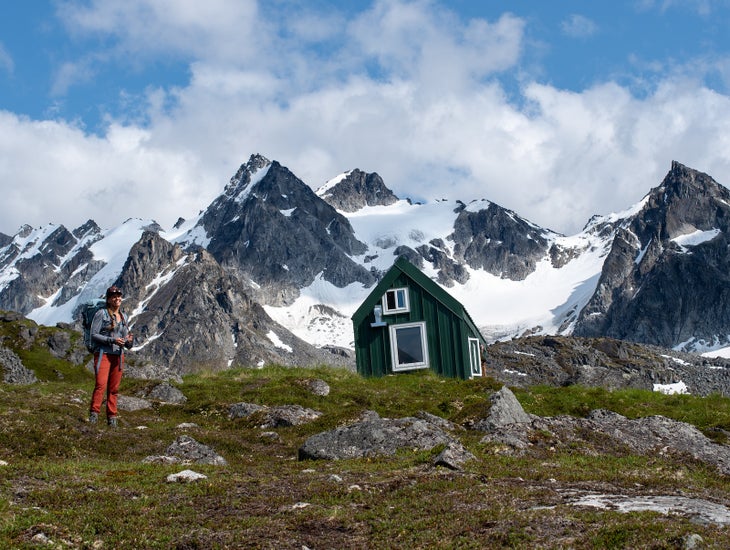
Day 2: Mint Hut to Bomber Hut
With less than 5 miles between the Mint and Bomber huts, day two is short in mileage but has some of the most exciting components of the whole traverse. Shortly after leaving Mint Hut, head up a steep, rocky moraine to the crux of the whole traverse: “Backdoor Gap,” a narrow, steep notch that separates the Little Susitna River and Wintergreen Creek drainages. Descending the west side of the gap onto Pennyroyal Glacier requires class 3 scrambling down a steep rock slope, made taller and more difficult over the years by Pennyroyal’s recession.
Like other glaciers along the traverse, Pennyroyal has had few, if any, crevasses in recent years. However, surface features can still be present, and exposed ice can be extremely slippery, especially in the rain. Experienced backpackers rarely rope up or wear helmets on Bomber Traverse glaciers, but they do bring microspikes or light crampons (before July, snowshoes may be preferable).
Hug the north side of Pennyroyal Glacier, where the angle is shallower, to avoid a steep and treacherous roll-over on the fall line. From the base of the glacier, continue over glacial rubble and tussocky tundra to the base of the Wintergreen Creek drainage, hop or wade across Wintergreen Creek, and ascend a tundra ridge to the Bomber Hut.

The Bomber Wreckage
The namesake of the Bomber Traverse is the wreckage of a TB-29 bomber that crashed in bad weather on the then-unnamed glacier in 1957. The bomber wreckage is not located along the official Bomber Traverse route; however, you can access it via an approximately 3-mile (round trip) side hike from the Bomber Hut. Because there are no signs or labels on the traverse, the path to the bomber wreckage crosses a boulder field that requires a bit of navigational prowess.
The history of the crash is tragic. On November 15, 1957, a crew of 10 in a TB-29 Superfortress—a variant of the B-29 bomber used in World War II—were conducting a navigational exercise in the Susitna River Valley when they encountered unexpected severe weather and veered off-course into the Talkeetna Mountains, where the plane slammed into a glacier. Six crew members survived the impact, but they faced a harsh battle against Alaska’s weather and it took several days for rescue crews to locate and extract the survivors. The wreckage of the plane has never been removed and has instead become a memorial. Today, twisted propellers, wheels, and large sections of the wings and fuselage remained scattered across the snow and ice.
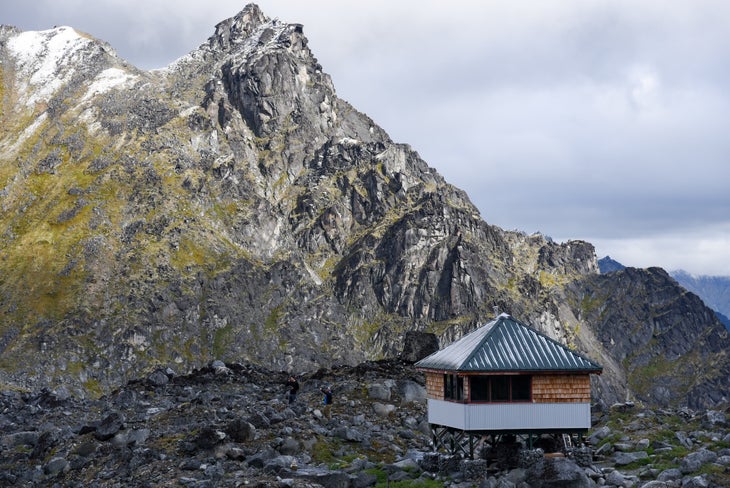
Day 3: Bomber Hut to Snowbird Hut
The third day involves a lower-elevation easy hike of just over 4 miles. Follow a gentle tundra ridge alongside Wintergreen Creek, sidehill through the brush on a light trail around the head of the Bartholf Creek drainage, and navigate up through a series of tundra benches to Snowbird Lake. From the edge of his beautiful large tarn, scramble alongside the creek spilling out of Snowbird Glacier and locate the hut on the crest of a prominent moraine on the northeastern edge of the glacier.
The Snowbird Hut was built between 2010 and 2011 to replace a geodesic “space dome” built on the same site in the mid-1980s. What the new hut lacks in grooviness it makes up for in grandeur. “The ’Bird” is located on the crest of the moraine above Snowbird Glacier, with spectacular views up the glacier and down the Bartholf drainage. It is the only hut in the system maintained by the American Alpine Club. There are few good campsites nearby due to the rocky and exposed terrain; snowbanks and glaciers nearby provide water. Plus: a “urine separating, solid waste dehydration” outhouse provides million-dollar views while you’re doing your business.
Day 4: Snowbird Hut to Reed Lakes Trailhead
The final day is just under 6 miles and almost entirely downhill, but it can be challenging in wet weather. Descend the moraine onto the surface of Snowbird Glacier. The surface of the glacier is nearly flat, though it may still have hazards. Climb up over Glacier Pass and then descend a light, informal trail through tundra and rock to the ruins of an old gold mine.
Below the mine, descend a steep brushy slope, connect with the Reed Lakes trail, and follow the path to the Reed Lakes parking lot. Staging a second vehicle at the Reed Lakes lot will make trip logistics much easier because there are no shuttle services in the area. If you only have one car, it’s a 3-mile walk on the road shoulder between the Reed Lakes and Gold Mint trailheads. After all of the uneven and difficult footing through the brush, over passes, and across glaciers, your feet will likely have to adjust to the strange feeling of walking on flat land again.
Note: Though the Bomber Traverse huts are free and open to the public, they are labors of love and require a large amount of volunteer time and money to operate. If you use and appreciate the huts, consider donating to the Mountaineering Club of Alaska (Mint Hut, Bomber Hut), and the American Alpine Club (Snowbird Hut).
From 2024