Plant-based clean energy solutions are on the horizon

At a laboratory at the Western Norway University of Applied Sciences (HVL) in Bergen, we find Professor Dhayalan Velauthapillai hard at work. Surrounded by young research fellows in white coats, he shows us the technology they are working on.
“We look at the world around us and search for materials that are easily available and with properties that make it possible to use them to capture energy,” he explains.
Take things found in nature
The key word is nanotechnology. Dhayalan is a physicist and conducts research on the smallest of particles.
More precisely, he is researching new nanomaterials that can be used for different applications, such as solar cells, hydrogen and energy storage.
“We take things found in nature and try to utilise the energy created when light hits the material,” he says.
The idea draws partly on photosynthesis, the process in which light energy is harnessed in plants. The experiments entail utilising the energy released in this process to produce electricity.
Nanotechnology deals with constructing, manipulating and using materials with new properties. By utilising the special properties of plants, for instance, and developing unique new nanomaterials, energy can be created in new areas.
Next generation solar cells
“This lets us create next generation solar cells. Instead of using conventional solar panels, you can paint solar cells directly on the wall of your home, for example,” Dhayalan says.
One of the research fellows at the laboratory illustrates this with a few pieces of thin film with nanomaterials in one hand and in the other, a small table fan that is plugged in. He then aims light directly on the small plate and the fan starts spinning.
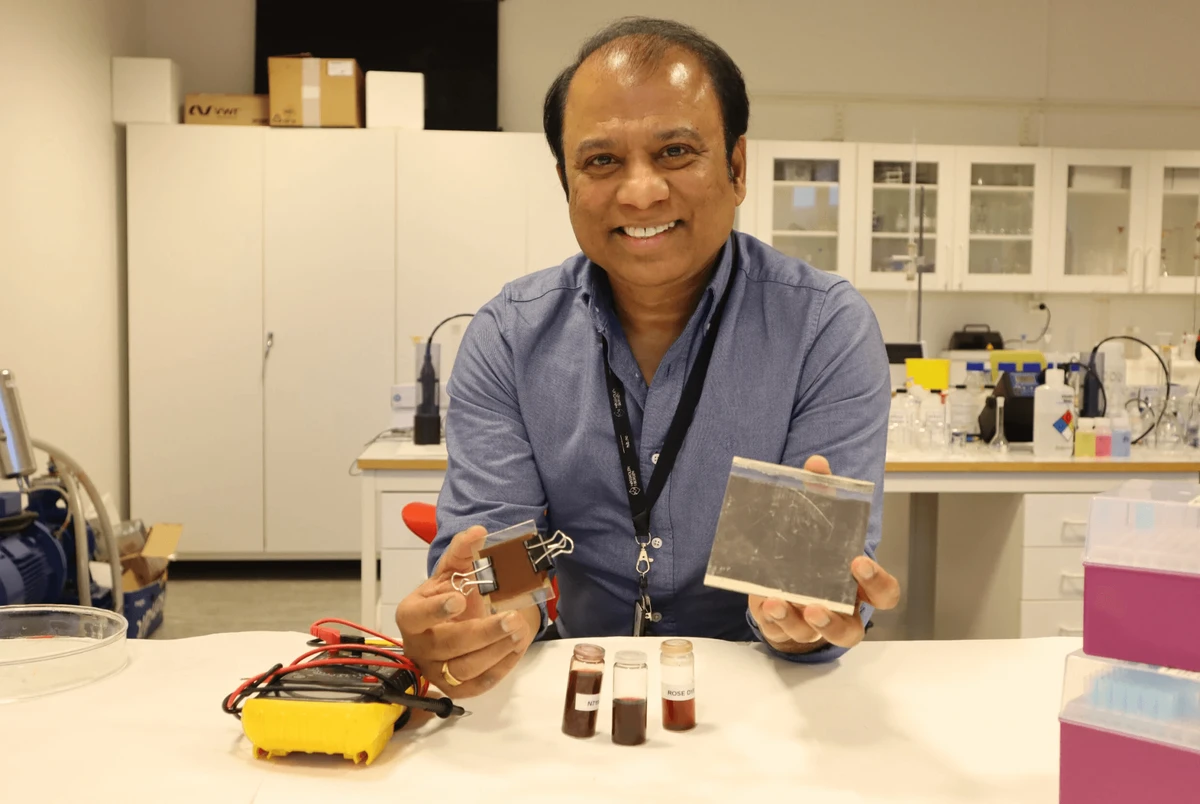
Such experiments are part of small-scale testing in the laboratories. Considerable research and development is still needed to apply this technology to a full-scale prototype, but Dhayalan is optimistic.
“In only a few years, we will see some of this technology in the market, but using current solar cell panels to create more energy with existing solutions,” he says.
Dhayalan hopes that in five to ten years we will be able to see a solution where, through new nanomaterials, we can paint solar cells directly on various surfaces to produce energy.
Making energy production more accessible
Today’s solar cell technology is an expensive investment for most people. An important goal for Dhayalan is to reduce the cost and make energy production more accessible. At the very least, this is important for poor countries in need of inexpensive and flexible solutions.
“Unlike first generation solar panels, these need to be cheaper to produce, easier to use and more environmentally friendly,” he explains.
Dhayalan knows first-hand how important this is. He fled from Sri Lanka in 1984 when a civil war broke out. After arriving in Norway, he studied to become a physicist and has gradually established a large international network.
Nowadays, he works as part of an international community of professionals in Great Britain, India, South Korea and Sri Lanka. The collaboration with Sri Lanka is especially close to his heart. Many of the research fellows under his mentorship are from there, and he has worked hard to develop research and education in renewable energy in Sri Lanka.
He recently visited his home country, which has been plagued by unrest and economic crisis, as well as an energy shortage and fuel rationing which has made everyday life a lot harder for people.
Solar cells in rainy Bergen?
It is an important reminder of the significance of research on new energy sources: It can also contribute to bringing peace.
If energy production can be made cleaner and more easily accessible, this can also have an impact on the climate and situation in poor countries.
It may seem like a paradox that new solar cell technology is being researched in rainy Bergen of all places. There are lots of myths about solar energy, such as that it is not effective in a country with little sun.
“You don’t need direct sunlight to produce energy with this new technology; all you need is regular daylight,” Dhayalan explains.
Nanomaterials for green hydrogen production
The nanomaterials that are the focus of Dhayalan’s research can be used for other applications. For example, his research community is exploring new ways to produce hydrogen using nanomaterials.
Research in this field is part of the activities being carried out at the new hydrogen research centre in Bergen, Hyvalue, of which HVL is one of several partners.
They are using one method to test new nanomaterials for use as electrodes commonly used to convert water into oxygen and hydrogen, and a second method to test the production of hydrogen without electrodes but using solar energy and nanomaterials.
“Again, the goal is to find cheaper and simpler alternatives for the production of green hydrogen,” Dhayalan explains.
They are also examining ways to use new nanomaterials for effective energy storage.
Growing interest
They say that new technology is often fuelled by crisis. There may be some truth to that. At any rate, Dhayalan has noticed that change is in the air.
“When I began working with this 15 years ago, few people were interested in solar energy and that kind of thing. But times have changed. I’ve noticed that the energy crisis has resulted in increased interest, also from the business community,” he says.
He believes there are three conditions for success:
“Firstly, people need to be aware of new energy technology, which is our responsibility. Secondly, the government needs to take a systematic approach to helping the research community and users. Thirdly, we need to work together with industry partners, both nationally and internationally,” he says.
Clean energy for all is one of the UN sustainable development goals. The climate crisis is creeping ever closer and there is no time to waste in finding new sustainable energy sources.
“We can’t wait – we have to continue pushing further with development,” Dhayalan concludes.
Read the original post here

 | Videos | More... |
Video: Nuclear energy will destroy us? Global warming is an existential threat? Chemicals are massacring bees? Donate to the Green Industrial Complex!
 | Bees & Pollinators | More... |

GLP podcast: Science journalism is a mess. Here’s how to fix it

Mosquito massacre: Can we safely tackle malaria with a CRISPR gene drive?

Are we facing an ‘Insect Apocalypse’ caused by ‘intensive, industrial’ farming and agricultural chemicals? The media say yes; Science says ‘no’
 | Infographics | More... |
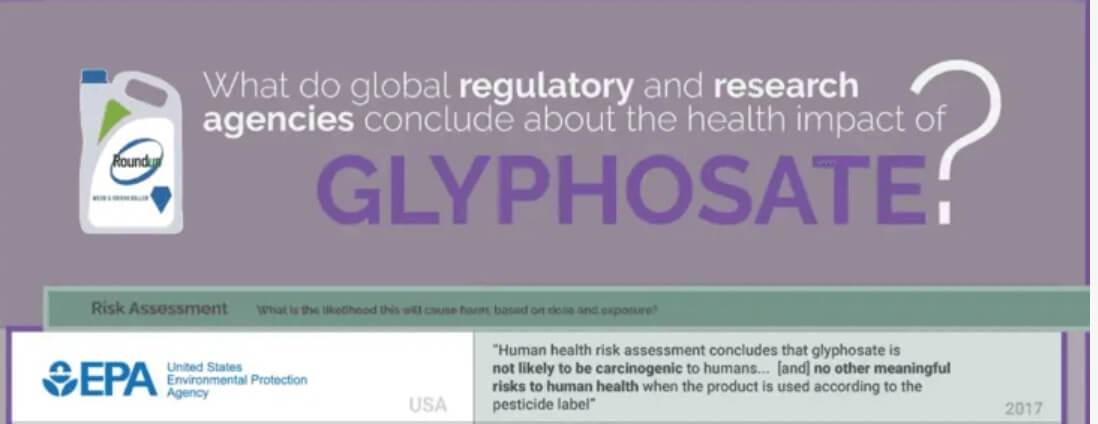
Infographic: Global regulatory and health research agencies on whether glyphosate causes cancer
 | GMO FAQs | More... |
Why is there controversy over GMO foods but not GMO drugs?

How are GMOs labeled around the world?
How does genetic engineering differ from conventional breeding?
 | GLP Profiles | More... |

Alex Jones: Right-wing conspiracy theorist stokes fear of GMOs, pesticides to sell ‘health supplements’

 Viewpoint — Fact checking MAHA mythmakers: How wellness influencers and RFK, Jr. undermine American science and health
 Viewpoint: Video — Big Solar is gobbling up productive agricultural land and hurting farmers yet providing little energy or sustainabilty gains
 Fighting deforestation with CO2: Biotechnology breakthrough creates sustainable palm oil alternative for cosmetics
 Trust issues: What happens when therapists use ChatGPT?
 California, Washington, Oregon forge immunization alliance to safeguard vaccine access against federal undermining
 30-year-old tomato line shows genetic resistance to devastating virus
 The free-range chicken dilemma: Better for birds, but with substantial costs
 ‘You have to treat the brain first’: Rethinking chronic pain with Sanjay Gupta