Say Goodbye, Guys: Shonen Jump Is Never Going to Have Another Naruto for One Reason
There was once a time whenShōnen Jump series would go on for ages. From Dragon Ball to Naruto, the list of long-running series goes on and on. However, due to the latest cancelation of Undead Unlock, the fandom is beginning to think Japanese publications like Shōnen Jump can no longer produce a long-running series. Series such as One Piece blew past 300 chapters with ease, leaving them to go on and become top franchises within the industry. Now, readers are worried the magazine is prematurely dumping series before they can develop into something we'd call a classic some decades from now.
Rather than letting a series flourish as it once did, manga's top magazine appears to be following a method adopted by Netflix. You know, the one that says if a property doesn’t catch on fast enough, it should be immediately dropped in favor of the next big thing. If this is the case, it appears readers won’t be getting another long-form series like Naruto in a long, long time. Though there are benefits to this business model, there's no denying it also comes with drawbacks.
The Benefits of Shōnen Jump Canceling Manga Early
Quick Turnover Provides Focused Stories and Fresh Voices For Readers
Admittedly, there is one good thing about short-lived manga. As a whole, these kinds of series are easy to get into as far as the plot is concerned. Many manga like Naruto and One Piece are impossible to read casually due to their length. Some of these long-running manga can span decades, so much like the Marvel Cinematic Universe, new fans have a high barrier of entry. One of the biggest complaints about One Piece, despite it being celebrated as one of the greatest tales in manga, is its chapter count which is well beyond 1,000 now. Shōnen Jump could be looking to step away from this lengthy model in exchange for quicker pick-up and readability.
In addition, a shorter story should give way to a more focused story. Oftentimes, long-running manga can meander and even lose track of its main objective to detour towards something else. When you are aiming for a smaller story, writers and publishers are less inclined to dilly-dally as they're racing towards a set shelf life. This kind of pace doesn't allow for breadth as a whole, but when done right, short manga titles are a fun one-and-one adventure.
Right now, Shōnen Jump has 23 titles in circulation, and each of these entries provides an opportunity for a new manga artist to make their mark. Although several artists like Yoshiro Togashi and Eiichiro Oda have spent their careers churning out chapters for this one magazine, they’re veteran in the game. They are used to a long haul, but that isn't the case for younger artists looking to make their break. Short projects allow Shōnen Jump to welcome a slew of artists to its magazine, giving more creators than ever before a turn in the spotlight.
There Are Consequences to Shōnen Jump Canceling Manga Too Early
From Rushed Finales to Incomplete Endings, We've Seen It All

Listen to this: Over 50 manga were canceled by Jump between 2018 and 2023. A handful of favorites like Green Green Greens and Cipher Academy, were cut down in their prime as well in 2024. And now, less than a month into 2025, another fan-favorite series is biting the dust with Undead Unluck. Although Shōnen Jump is no stranger to canceling manga, it feels more cutthroat now than it has in the last seven years.
Some of Shōnen Jump's modern hits, Jujutsu Kaisen and My Hero Academia, were even accused of rushing their finales despite their financial success. More than once, Shōnen Jump has ushered a series into its final arc only for the manga's plot points to be skipped and have its main objective thrust ahead. To make things worse, readers rarely get advance warning when a series is ending; Most projects are lucky to get a week's notice let alone a month. This lack of transparency is a big reason readers have trouble getting invested in new manga.
As Netflix users will attest, it’s scary to get attached to a new series when there’s a solid chance it’ll be canceled mid-run or end without warning. If readers aren't willing to invest, even more manga end up being canceled, and the vicious cycle continues. Conversely, if there are too many titles on the table, readers can detach from the overload. The less time a manga has to find its audience, the less time it has to leave an impact. So if Shōnen Jump continues to follow Netflix's business model, it could cause more harm than good.
Shōnen Jump Canceling Manga Early Does More Harm Than Good
It’s Not Worth Toying With Our Emotions To Find A Diamond In The Rough
Shōnen Jump could find itself in a rough position once One Piece finally ends. The manga stands as the last of the magazine's fabled Big 3, a trio of titles so big that they defined the industry for decades. Crafting a new set of flagship titles is admittedly difficult given Shōnen Jump's new business model. Given how quickly manga are being canceled, the best chance titles have at success comes in anime. The faster an anime adaptation is ordered, the better visibility a manga gets at Shōnen Jump. Current hits like Dandadan and Sakamoto Days garnered popularity this way, so it's easy to see this model of success.
While short stories are fun to read, the long-term health of Shōnen Jump must consider the future. It’s hard to spin short, contained stories into widespread franchises as was done with Naruto. If Shōnen Jump continues to cancel and rush manga, instead of creating the next Naruto, it’ll end up going under.
- Created by
- Takashi Isono, Kazuhiko Torishima
- First Film
- Dragon Ball: Curse of the Blood Rubies
- Latest Film
- One Piece Film: Red
- First TV Show
- Dr. Slump
- Latest TV Show
- Kaiju No. 8
- Upcoming TV Shows
- Dragon Ball DAIMA, Sakamoto Days
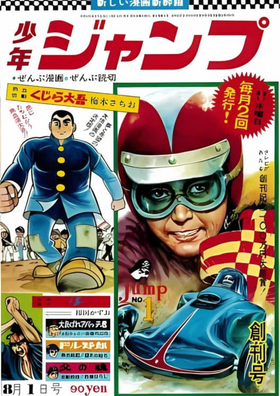
Shonen Jump is one of Japan's most successful manga anthology franchises, published by Shueisha. Launched in 1968, it is the source of some of the most beloved and popular anime and manga series, such as One Piece, Dragon Ball, and Naruto. The franchise has extended into multiple adaptations across various media, including anime, films, video games, and merchandise.
- First Episode Air Date
- April 8, 1981
- Cast
- Mayumi Tanaka, Junko Takeuchi, Masako Nozawa, Masakazu Morita, Daiki Yamashita, Natsuki Hanae, Junya Enoki, Megumi Han, Kazuyuki Okitsu, Mamoru Miyano, Nozomu Sasaki, Gakuto Kajiwara, Yûsuke Kobayashi, Ayumu Murase, Sumire Morohoshi, Yoshitsugu Matsuoka, Kensho Ono, Ryôtarô Okiayu
- Current Series
- Jujutsu Kaisen, My Hero Academia, Kaiju No. 8
- TV Show(s)
- One Piece, Naruto, Naruto: Shippuden, Dragon Ball, Dragon Ball Z, Bleach, My Hero Academia, Demon Slayer: Kimetsu no Yaiba, Jujutsu Kaisen, Hunter x Hunter, Hunter x Hunter, JoJo Bizarre Adventure, Death Note, Yu Yu Hakusho: Eizou Hakusho, Black Clover, Dr. Stone, Haikyuu!!, The Promised Neverland, Food Wars!: Shokugeki No Soma, Kuroko's Basketball, Tokyo Ghoul, Toriko
- Video Game(s)
- J-Stars Victory VS+, Jump Force