Sn-Enhanced Catalyst Significantly Improves Diesel Emission Control Performance
Sn-Enhanced Catalyst Significantly Improves Diesel Emission Control Performance
In a groundbreaking development in the realm of diesel emission control technology, a team of researchers has unveiled a novel catalyst that promises to dramatically improve the efficiency and durability of selective catalytic reduction (SCR) systems used to mitigate harmful nitrogen oxide (NOₓ) emissions. This advancement emerges as a timely contribution toward addressing increasingly stringent global emission standards, such as those mandated by the Chinese VI and European VI regulations, which demand robust catalytic converters capable of enduring harsh operating conditions while maintaining peak performance.
Nitrogen oxides are notorious contributors to environmental degradation, playing a pivotal role in the formation of acid rain, urban smog, and overall atmospheric pollution. Diesel engines, while efficient, have historically posed significant challenges in controlling NOₓ emissions due to the high temperatures and complex exhaust gas compositions. The SCR technology utilizing ammonia (NH₃) as a reductant has been the cornerstone of modern NOₓ abatement strategies in diesel vehicles. However, the operational realities of these systems, especially under the extreme thermal stresses imposed during diesel particulate filter (DPF) regeneration, require catalysts with exceptional thermal and hydrothermal stability.
Addressing this challenge, the research team synthesized a tin (Sn)-modified mixed oxide catalyst comprising cerium (Ce), niobium (Nb), and oxygen, formulated as Ce₁Sn₂Nb₁Oₓ, through a refined co-precipitation method. This approach ensured precise control over the catalyst’s microstructure and the uniform distribution of its constituent elements. The integration of tin into this mixed oxide framework was hypothesized to not only enhance the catalytic activity for NH₃-SCR but also improve the material’s resilience against sintering and deactivation at elevated temperatures.
Comprehensive evaluations of catalytic performance demonstrated that the Sn-modified Ce–Nb catalyst exhibited a remarkable NH₃-SCR activity, achieving over 90% NOₓ conversion within the critical temperature window of 325–500 °C. This performance was notably sustained even after rigorous hydrothermal aging at temperatures as high as 1000 °C, a condition that simulates the extreme environment encountered during DPF regeneration cycles. In stark contrast, the unmodified Ce₁Nb₁Oₓ catalyst and a benchmark commercial Cu-SSZ-13 catalyst displayed significantly deteriorated NOₓ conversion rates following similar aging protocols.
The profound enhancement in catalyst durability and activity can be attributed to multiple intertwined physicochemical factors elucidated through a battery of sophisticated characterization techniques. Nitrogen physisorption analyses revealed that the incorporation of Sn markedly increased the specific surface area and total pore volume of the catalyst, factors intimately linked with the availability of active catalytic sites. Simultaneously, X-ray diffraction (XRD) and in-situ high-temperature XRD measurements delineated that Sn addition suppressed grain growth, thereby mitigating the agglomeration of active phases that commonly leads to catalyst deactivation under thermal stress.
At the atomic scale, the stabilization effects manifested prominently in the coordination environment of niobium species, which are crucial for the redox and acid-base functionalities requisite for effective NH₃-SCR catalysis. The presence of Sn was found to preserve these coordination structures, effectively guarding against hydrothermal degradation mechanisms that erode catalytic performance. This structural stability ensures that key reaction sites remain accessible and active throughout the prolonged and severe temperature excursions typical of real-world diesel aftertreatment systems.
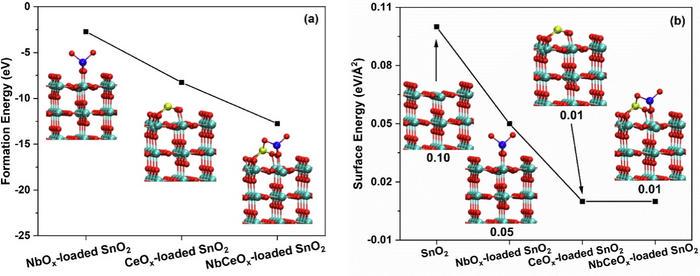
To gain deeper mechanistic insights, density functional theory (DFT) calculations were employed to simulate the interaction dynamics of the mixed oxide catalyst surfaces. These theoretical evaluations confirmed that dispersed CeOₓ and NbOₓ species anchored on the SnO₂ surface coalesce to form highly efficient and stable NbCeOₓ active motifs. These motifs play a pivotal role in maintaining the redox properties and acidity of the catalyst, essential parameters that facilitate the selective reduction of NOₓ by ammonia while withstanding the hydrothermal rigors encountered during operation.
The synergy achieved through Sn modification of Ce–Nb mixed oxides delineates a new pathway in the design of sintering-resistant catalysts that can meet and exceed the demands imposed by next-generation diesel emission standards. By ensuring sustained catalytic activity across an expansive temperature range and under extreme aging conditions, this catalyst addresses the perennial challenge of catalyst longevity without compromising emission control efficacy.
The implications of this research extend beyond the immediate context of diesel exhaust treatment. By enhancing catalyst resilience and activity, this development offers a scalable and economically viable strategy for reducing the environmental footprint of diesel vehicles worldwide. Such advances are pivotal in the global quest to curtail air pollution and mitigate the health impacts associated with NOₓ emissions, especially in densely populated urban and industrial areas.
The study’s convergence of experimental rigor and theoretical modeling embodies a modern approach to catalyst development, underscoring the role of atomic-level design in overcoming macroscopic operational challenges. The comprehensive exploration of structural, surface, and electronic properties has yielded a material system with a unique blend of activity, stability, and durability — attributes quintessential for durable environmental catalysis.
By fostering a deeper understanding of the interplay between catalyst composition, structure, and performance, this work opens avenues for further enhancements in SCR technology. Future research may explore the fine-tuning of Sn content, dopant distribution, and synthesis parameters to tailor catalyst properties for specific operational environments, including varying exhaust compositions and temperature profiles.
In summary, the realization of the Ce₁Sn₂Nb₁Oₓ catalyst marks a significant milestone in the continuing evolution of emission control technologies. Its demonstrated ability to maintain superior NOₓ conversion efficiency after exposure to severe hydrothermal conditions advances the practical deployment of durable NH₃-SCR catalysts capable of meeting stringent pollutant regulations. This breakthrough offers hope for cleaner diesel technologies and improved air quality globally, reflecting a successful integration of materials science innovation into environmental engineering practice.
Subject of Research: Enhancement of NH₃-SCR catalytic activity and hydrothermal stability of Ce–Nb mixed-oxide catalysts through Sn modification for diesel vehicle NOₓ emission control.
Article Title: Remarkable Enhancement of the Activity and Hydrothermal Stability of a CeO₂-Based NH₃-SCR Catalyst by Sn Modification
Web References:
- Full article: https://doi.org/10.1016/j.eng.2024.02.011
- Journal Engineering homepage: https://www.sciencedirect.com/journal/engineering
Image Credits: Ying Zhu et al.
Keywords
Chemical engineering; Catalyst design; NH₃-SCR; Diesel emission control; Hydrothermal stability; CeO₂-based catalysts; Tin modification; NbCeOₓ active species; Density functional theory; Catalytic durability; Selective catalytic reduction; Environmental catalysis
PolyU Research Reveals Hidden Microbial Dangers from Plastic Waste, Calls for Global Efforts to Monitor Harmful Microbiomes
Next PostScientists Harness 3-D Printing to Enhance Comfort and Durability of Smart Wearables
Related Posts

Smoking or Vaping Could Elevate Your Risk of Developing Diabetes, New Study Finds
Metasurface Revolutionizes Atomic Magnetometers with Enhanced Compactness and Sensitivity
New Study Highlights the Promise of Collagen-Based Micro/Nanogels in Medical Applications
Breakthroughs in Exciton-Polariton Research within Perovskite Materials
2D X-Ray Imaging Unveils Hidden Processes in CO₂ Electrolyzers