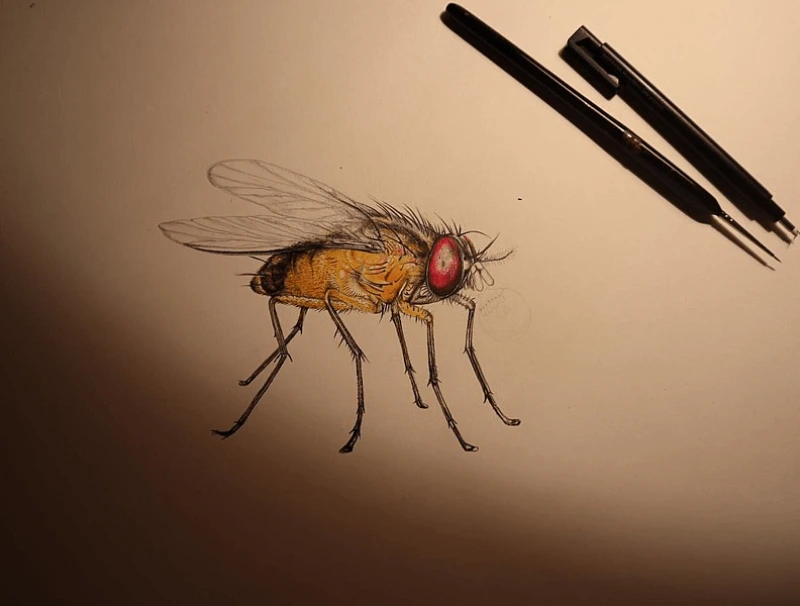
Researchers have developed a “homing gene drive system” based on CRISPR/Cas9 that could be used to suppress populations of Drosophila suzukii vinegar flies—so-called “spotted-wing Drosophila” that devastate soft-skinned fruit in North America, Europe and parts of South America—according to new research from North Carolina State University.
The NC State researchers developed dual CRISPR gene drive systems that targeted a specific D. suzukii gene called doublesex, which is important for sexual development in the flies. CRISPR stands for “clustered regularly interspaced short palindromic repeats” and Cas9 is an enzyme that performs like molecular scissors to cut DNA. CRISPR systems are derived from bacterial immune systems that recognize and destroy viruses and other invaders, and are being developed as solutions to problems in human, plant and animal health, among other uses.
Targeting the doublesex gene resulted in female sterility in numerous experiments as females were unable to lay eggs, says Max Scott, an NC State entomologist who is the corresponding author of a paper in Proceedings of the National Academy of Sciences that describes the research.
“This is the first so-called homing gene drive in an agricultural pest that potentially could be used for suppression,” Scott said.
Gene drives can preferentially select, change or delete particular traits or characteristics and “drive” those edits through future generations, resulting in a sometimes far greater than 50% chance of passing those changes to progeny.
“Gene drive means biased inheritance,” Scott said.
Researchers used a fluorescent red protein to mark the presence of the CRISPR/Cas9 genetic change to the fly’s genetic blueprint, or genome. The gene drive systems transmitted that fluorescent protein to 94-99% of progeny, the paper reports.
The researchers also used mathematical modeling to predict how efficiently the gene drive system would suppress a given D. suzukii population in laboratory cages. The modeling showed that releasing just one modified fly for every four “wild” flies—those not genetically modified—could tank fly populations within approximately eight to 10 generations.
“Because doublesex is such a conserved gene required for female development in so many fly species, I think the homing gene drive strategy could be used for other pests,” Scott said.
Scott and collaborators previously showed success in suppressing D. suzukii populations using a strain that produces only males and also used a similar method to reduce lab populations of the New World screwworm fly.
Next steps include contained trial experiments in cages in an NC State greenhouse.
“We’re doing small population cage suppression experiments. We’re hoping to learn if repeated fly releases with a 1:4 ratio will suppress fly populations in a cage like the modeling suggests,” Scott said.
Read the original post here

















 Viewpoint — Fact checking MAHA mythmakers: How wellness influencers and RFK, Jr. undermine American science and health
 Viewpoint: Video — Big Solar is gobbling up productive agricultural land and hurting farmers yet providing little energy or sustainabilty gains
 Fighting deforestation with CO2: Biotechnology breakthrough creates sustainable palm oil alternative for cosmetics
 Trust issues: What happens when therapists use ChatGPT?
 California, Washington, Oregon forge immunization alliance to safeguard vaccine access against federal undermining
 30-year-old tomato line shows genetic resistance to devastating virus
 The free-range chicken dilemma: Better for birds, but with substantial costs
 ‘You have to treat the brain first’: Rethinking chronic pain with Sanjay Gupta