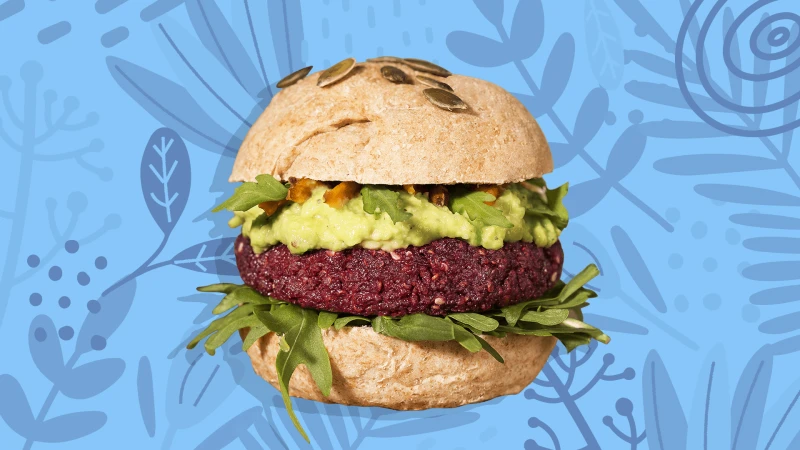
There are increasingly strong reasons to move away from industrial animal agriculture for the good of the environment, animals, our personal health, and public health. Plant-based animal product alternatives (PB-APAs) represent a highly feasible way to reduce animal product consumption, since they address the core consumer decision drivers of taste, price, and convenience. PB-APAs tend to displace demand for animal products, not other plant foods, and are more able to do this compared to whole plant foods alone.
This paper reviews 43 studies on the healthiness and environmental sustainability of PB-APAs compared to animal products. In terms of environmental sustainability, PB-APAs are more sustainable compared to animal products across a range of outcomes including greenhouse gas emissions, water use, land use, and other outcomes.
In terms of healthiness, PB-APAs present a number of benefits, including generally favorable nutritional profiles, aiding weight loss and muscle synthesis, and catering to specific health conditions. Moreover, several studies present ways in which PB-APAs can further improve their healthiness using optimal ingredients and processing. As more conventional meat producers move into plant-based meat products, consumers and policymakers should resist naturalistic heuristics about PB-APAs and instead embrace their benefits for the environment, public health, personal health, and animals.
Conclusion
The problems with our current protein production system are many and severe, affecting the planet, human health, and animal welfare. PB-APAs offer a healthier and more environmentally sustainable solution which takes into account consumer preferences and behaviour. They are consumed in place of animal products, and should therefore be compared with such products. PB-APAs are found to be preferable from an environmental perspective in terms of greenhouse gas emissions, water use, land use, and they do not contribute to the growing global health threats of antibiotic resistance or pandemic risk. They are also preferable from a nutritional perspective in terms of saturated fat, cholesterol, fibre, and a range of other nutrients.
Moreover, with further developments in processing and formulation, PB-APAs have the potential to improve their nutritional profile even further, as well as improving across other metrics such as taste, texture, price, cooking properties, and sustainability. Additional research funding is of paramount importance to making these potential improvements a reality, and also to test early indications that these products offer health benefits when compared to their traditional counterparts. This product category is in its infancy, and products will inevitably improve, particularly if the industry follows its significant growth in sales from recent years.
However, policymakers must be aware of the potential hazards with respect to biased consumer perceptions. Although most consumers correctly view PB-APAs as more nutritionally sound alternatives, their perception as unnatural or overly processed can lead some to incorrectly infer that they are unhealthy and/or harmful in other ways. This perception may be exacerbated by interests in the conventional animal product industry who seek to cast public doubt on these competing products. Consumers and policymakers must resist the heuristic that animal meat is natural and therefore better, and instead listen to the science, which suggests that PB-APAs can be a sustainable and healthy part of our future protein landscape.
This is an excerpt. Read the original post here
















 Viewpoint — Fact checking MAHA mythmakers: How wellness influencers and RFK, Jr. undermine American science and health
 Viewpoint: Video — Big Solar is gobbling up productive agricultural land and hurting farmers yet providing little energy or sustainabilty gains
 Fighting deforestation with CO2: Biotechnology breakthrough creates sustainable palm oil alternative for cosmetics
 Trust issues: What happens when therapists use ChatGPT?
 California, Washington, Oregon forge immunization alliance to safeguard vaccine access against federal undermining
 30-year-old tomato line shows genetic resistance to devastating virus
 The free-range chicken dilemma: Better for birds, but with substantial costs
 ‘You have to treat the brain first’: Rethinking chronic pain with Sanjay Gupta