Video: ‘Media bashing of pesticides is hysteria wrapped around a kernel of truth’: Rethinking essential crop protection tools
Video: ‘Media bashing of pesticides is hysteria wrapped around a kernel of truth’: Rethinking essential crop protection tools
Ashley Robinson, Ian Affleck, Stuart Smyth | Seed World | January 6, 2023
XLinkedInFacebookRedditBlueskyThreads
The media will often spin facts to fit the story they’re trying to tell. Credit: Rachel Kogut
This article or excerpt is included in the GLP’s daily curated selection of ideologically diverse news, opinion and analysis of biotechnology innovation.
Headlines about agriculture chemical use aren’t always the most kind to the industry. And while these headlines may be flashy and attention grabbing, they’re usually overblown with consumers not being given the full truth.
“It can be a hard pill to swallow when you read some of these. They are often rooted in a kernel of truth that is then taken way out of context. And that’s what’s really frustrating,” Ian Affleck, vice president of plant biotechnology at CropLife Canada, says on the Dec. 14 episode of Seed Speaks.
Affleck says he has found these stories will use data from the Canadian Food Inspection Agency (CFIA), the Canadian government department in charge of food safety, and will spin it to fit the story they’re trying to tell. He adds the CFIA has pesticide allowance levels that are set at 100 to 1,000 times below the level that could cause harm to humans.
Follow the latest news and policy debates on sustainable agriculture, biomedicine, and other ‘disruptive’ innovations. Subscribe to our newsletter.
“We’ll often see headlines about pesticides residues being found on food. Understandably, that can sound alarming to consumers. But what’s left out is the context about how most foods have no detectable residues and those that do are at levels far below those that would pose a risk to our health and safety. Context matters,” he adds.
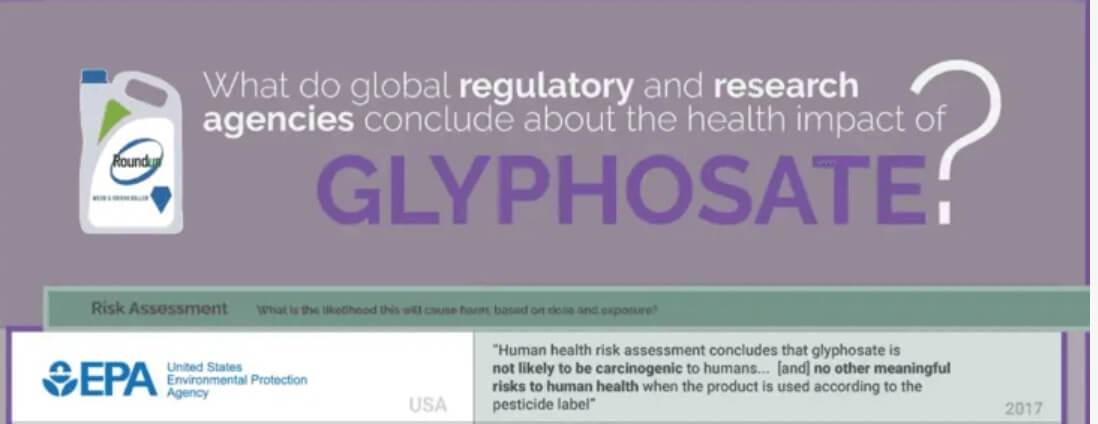
Stuart Smyth, an associate professor in the Department of Agricultural and Resource Economics at the University of Saskatchewan, has found there’s lots of deliberate misinformation out there. Recently he’s seen social media posts saying strawberries are doused in glyphosate, however if that was true then the strawberries would die.
“Activist opponents to the use of chemicals or the roles of chemicals in agriculture, are taking advantage of the public’s lack of knowledge and trying to deliberately misinform them about the safety of food products,” Smyth explains in the episode.
Both Affleck and Smyth have found consumers have a real fear around chemical usage in agriculture as they struggle to see the benefits of it. While they may use chemicals in their everyday lives, they don’t have the same connection with ag chemicals which feeds into their fear of them.
“I think a lot of society has the perception that zero risk is very achievable, and it won’t raise the cost of anything. And the reality is that the lower and lower the threshold, the closer you get to zero, the significantly higher the cost of providing any product or technology is,” Smyth says.
Ag chemical usage has changed with technology advancements over the decades. While that does mean farmers today are using more products than they did 50 years ago, they’re being used in a more precise way. With crop production having moved away from being tillage intensive it has changed how chemicals are used while also providing environmental benefits.
“It allowed us to farm our land so much more efficiently, to control weeds and insects and pests. And it’s pretty devastating if you look at the data – if you didn’t have crop protection products available – the amount of land you would need to produce the same amount of food would be pretty shocking and devastating for biodiversity,” Affleck explains.
Both agree that at the end of day access to agriculture chemicals helps provide food security around the world.
A version of this article was originally posted at Seed World and is reposted here with permission. Seed World can be found on Twitter @SeedWorldMag
The GLP featured this article to reflect the diversity of news, opinion and analysis. The viewpoint is the author’s own. The GLP’s goal is to stimulate constructive discourse on challenging science issues.
The GLP Needs Your Help
It is easier than ever for advocacy groups to spread disinformation on pressing science issues, such as the ongoing coronavirus pandemic. No, vaccines are not harmful. Yes, the use of biotechnology, GMOs or gene editing to develop antigens for treatments including vaccines are part of the solution. To inform the public about what’s really going on, we present the facts and challenge those who don't. We can’t do this work without your help. Please support us – a donation of as little as $10 a month helps support our vital myth-busting efforts.














 Viewpoint — Fact checking MAHA mythmakers: How wellness influencers and RFK, Jr. undermine American science and health
 Four ways to strip carbon out of agriculture and limit farming’s climate impacts
 Viewpoint: Video — Big Solar is gobbling up productive agricultural land and hurting farmers yet providing little energy or sustainabilty gains
 Confronting the elephant in the human biodiversity room — the explosive issue of IQ
 Fighting deforestation with CO2: Biotechnology breakthrough creates sustainable palm oil alternative for cosmetics
 Trust issues: What happens when therapists use ChatGPT?
 California, Washington, Oregon forge immunization alliance to safeguard vaccine access against federal undermining
 30-year-old tomato line shows genetic resistance to devastating virus
 The free-range chicken dilemma: Better for birds, but with substantial costs
 ‘You have to treat the brain first’: Rethinking chronic pain with Sanjay Gupta