Viewpoint: Could a GMO herbicide-resistant milkweed help save the Monarch butterfly?

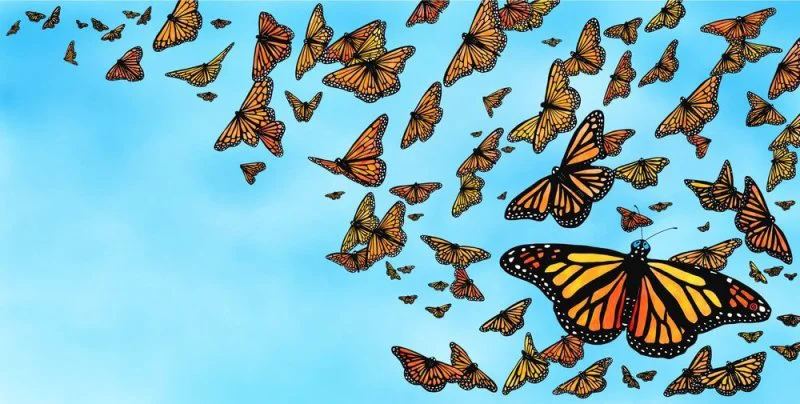
Sobering news broke this month for those of us who love monarch butterflies – and who doesn’t? Those black and orange icons that engage in multi-generational migration from Canada, across the Midwestern United States to Mexico and back, just drifted closer to extinction: They are now officially endangered. The International Union for the Conservation of Nature has added our monarch to its infamous Red List, marking what’s become obvious to those of us who delight in watching them flutter and float: Year after year, there are fewer of them in our skies.
Not only do these commuting monarchs mysteriously change from striped caterpillars into majestic butterflies, but they defy human logic with their ultra-long-distance flight path. Their navigational details remain a mystery, but what’s no mystery is why they face extinction.
Milkweed is the monarch’s sole host plant. Monarchs lay their eggs only on milkweed. The larvae from those eggs eventually feed on milkweed, filling them up with a chemical compound that makes them poisonous for most potential predators. Monarch larvae eat only milkweed. Killing off the milkweed means killing off the monarchs. And we are killing off the milkweed.
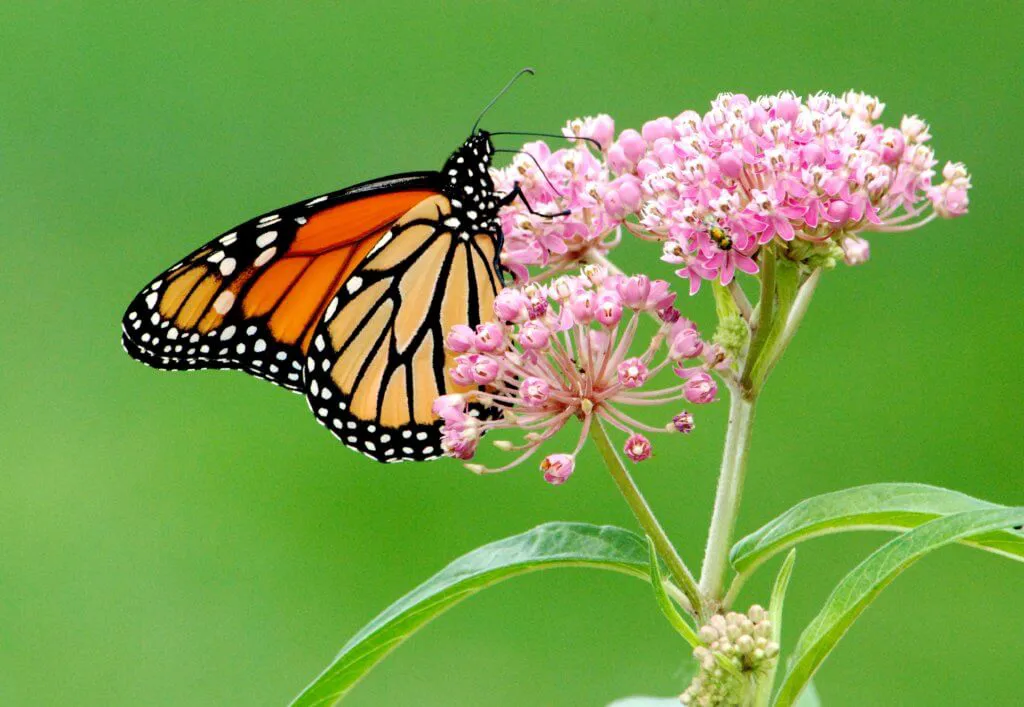
Across North America, milkweed is disappearing in direct relationship to the planting of massive amounts of genetically modified corn and soybeans. Farmers keep weeds out of their fields with glyphosate-based herbicides. Milkweed in the fields withers, turns brown, and dies, while Roundup Ready crops – grown from seeds created in the lab to tolerate glyphosate – thrive.
For years monarch researchers and aficionados have worked to save milkweed, and hence, monarchs. From backyard butterfly gardens to long swaths of roadsides, every effort at conserving milkweed is good news. But it’s not enough to counter the Roundup-caused devastation of milkweed.
As I pondered the potential loss of the monarchs in our midst, a thought began to take form: Could guerrilla botanists take advantage of bestselling Roundup to help save the struggling butterfly? Could hackers develop a Roundup-resistant milkweed and preserve the monarch larva’s sole food source?
I checked in with one of my favourite butterfly experts, University of California, Davis, entomologist Arthur Shapiro. When I proposed the Roundup Ready milkweed idea, he took a breath and, I was pleased to realize, considered it as a serious question. The scheme could work, he mused, “so long as the genetic change which rendered the milkweed Roundup Ready was not in any way inimical to monarch activity,” and then he listed those activities: egg laying, growth and development. “That would have to be tested empirically to be sure that the genetically modified milkweed was acceptable to monarchs. One thing for sure,” he said, “it would be highly controversial.”
As I was researching this far-fetched Roundup Ready milkweed plot, I happened on a New York Times article from several years back about the escalating milkweed and monarch crisis. Chip Taylor from Monarch Watch is quoted as offering what Times reporter Andrew Pollack calls in his story “a modest, possibly ironic proposal to biotechnology companies.” Dr. Taylor said, “I would implore them to develop a Roundup-resistant milkweed.” Not really, Dr. Taylor told me in a follow-up interview. “For years I’ve been joking about this, but I would never advocate it.” Dr. Taylor worries Roundup-resistant milkweed would result in farmers spreading different chemical poisons on their land to counter invasive genetically modified milkweed.
Perhaps Roundup Ready milkweed could be an interim fix. First, we need a team of biohackers who clone the gene that prevents glyphosate from performing its deadly deed (Roundup’s creator, the agrochemical company Monsanto, found it for its patented corn and soybeans in bacteria growing near its factory). Then Team Milkweed mashes that gene into milkweed chromosomes. The result: Roundup Ready milkweed. Finally, the revolutionaries immediately must proclaim their handiwork an open-source invention so others can sow what they reaped. That will prevent Bayer (which bought Monsanto and retired the tarnished trade name) and other agrochemical companies from grabbing rights to genetically modified milkweed in order to keep it off farms.

After our first successful genetically modified milkweed blooms, it’s time to propagate it wherever glyphosate is killing the native milkweed – and keep our fingers crossed for the regal monarch. Native-plant enthusiasts might well resist the arrival of genetically modified milkweed. There’s a nursery down the street from my house, for example, that wouldn’t approve; it prides itself on selling only organic products. “Save the monarch,” yells a sign there, “plant milkweed.” It’s a fine campaign for our California suburb, but that organic milkweed wouldn’t survive Roundup drenching in soybean and corn fields any better than the wild milkweed that’s been dying from the poison. Sometimes survival – in this case the monarchs’ – requires a radical response. Of course, unintended consequences must be considered.
What new crises might be caused by propagating Roundup Ready milkweed? Would it be worth the risk? Perhaps those questions are best answered by the work of the late monarch expert, Lincoln Brower. Dr. Brower, a biology professor at Sweet Briar College, spent much of his career studying monarchs and their migration from Canada to Mexico and back. Dr. Brower died at the age of 86, in 2018. Years ago, we chatted about monarch habitat loss. Dr. Brower summed up the problem with a succinct, “I think humanity is a disaster for this planet.” The bad news for the butterflies is that there’s no clear and easy answer to the mess we humans have made by creating threats, including deforestation and climate change, that plague the monarchs.
Read the original post here
 | Videos | More... |

Video: Nuclear energy will destroy us? Global warming is an existential threat? Chemicals are massacring bees? Donate to the Green Industrial Complex!
 | Bees & Pollinators | More... |

GLP podcast: Science journalism is a mess. Here’s how to fix it

Mosquito massacre: Can we safely tackle malaria with a CRISPR gene drive?

Are we facing an ‘Insect Apocalypse’ caused by ‘intensive, industrial’ farming and agricultural chemicals? The media say yes; Science says ‘no’
 | Infographics | More... |

Infographic: Global regulatory and health research agencies on whether glyphosate causes cancer
 | GMO FAQs | More... |

Why is there controversy over GMO foods but not GMO drugs?

How are GMOs labeled around the world?

How does genetic engineering differ from conventional breeding?
 | GLP Profiles | More... |

Alex Jones: Right-wing conspiracy theorist stokes fear of GMOs, pesticides to sell ‘health supplements’

 Viewpoint — Fact checking MAHA mythmakers: How wellness influencers and RFK, Jr. undermine American science and health
 Viewpoint: Video — Big Solar is gobbling up productive agricultural land and hurting farmers yet providing little energy or sustainabilty gains
 Fighting deforestation with CO2: Biotechnology breakthrough creates sustainable palm oil alternative for cosmetics
 Trust issues: What happens when therapists use ChatGPT?
 California, Washington, Oregon forge immunization alliance to safeguard vaccine access against federal undermining
 30-year-old tomato line shows genetic resistance to devastating virus
 The free-range chicken dilemma: Better for birds, but with substantial costs
 ‘You have to treat the brain first’: Rethinking chronic pain with Sanjay Gupta