Kenya wants its farmers to grow pest-resistant, drought-tolerant corn, as pests devour much of its corn crop, and Kenya faces its worst drought in over 40 years. For five years, drought has decimated Kenya’s corn crop. For eight years, fall armyworm moths have ravaged Kenya’s corn crop, destroying a third of Kenya’s annual production.
So Kenya’s cabinet imported 11 tons of corn seeds genetically modified to be pest-resistant and drought-resistant last year. But this February, four lawsuits were brought over the seeds by an environmentalist group and others, resulting in legal blocks against their distribution. Kenya’s GMO regulator was barred from releasing the seeds, pending a future court hearing. So farmers can’t plant the seeds, keeping them from producing enough food to feed Kenya’s people.
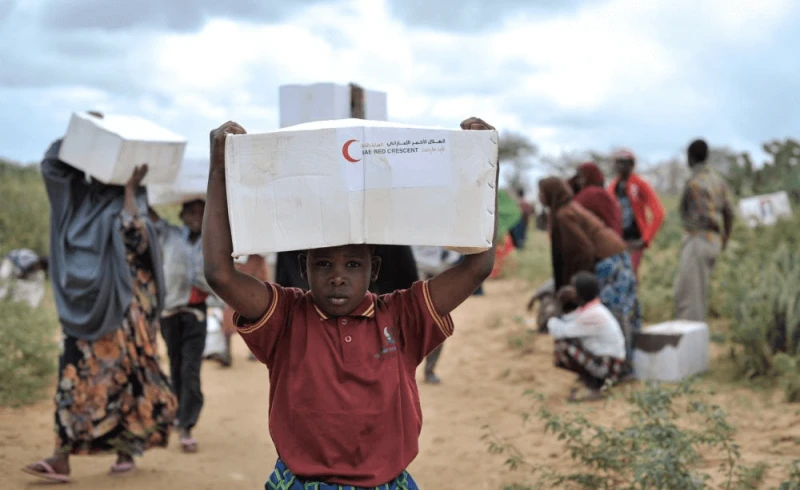
Meanwhile, in Kenya’s arid north, rivers have dried up and millions of livestock have already died due to lack of food. Over four million Kenyans don’t have enough to eat, and the situation will get worse if the coming rainy season fails like the previous five. “I’ve never seen it so bad. There’s nothing in the farms, the drought is too harsh,” says Daniel Magondo, a corn and cotton farmer in central Kenya. The U.S. government has stepped in with $126 million in food aid, citing “more than 970,000 children ages five and younger” who “are acutely malnourished across the country.”
Genetically-modified crops help the environment, by reducing the consumption of land, water, pesticides, and fertilizer, and increasing crop yields. As Ars Technica notes,
Improving crop yields helps feed more people, but it’s also good for the environment. The more food that can be grown on each square kilometer of land, the less land that needs to be converted to agriculture. As you can see in this chart from Our World in Data, South Asia produces a lot more cereal crops today than it did in 1980—and all of this growth came from increased crop yields. It’s not using any more land to grow those crops than it was 40 years ago. In sub-Saharan Africa it’s the opposite story. The area is also producing more cereals than in 1980, but almost all of this growth has come from converting more land into farmland. Low crop yields mean that feeding more people comes at the expense of natural habitats.
GM crops might be one way to increase yields. In South Africa, GM maize fields produce 11.1 percent more per hectare on average than non-GM fields—extra maize that would have taken more than 2,000 square kilometers of extra farmland to produce using conventional seeds.
Kenya already plants genetically-modified cotton, which has improved its environment and its economy. As Kenyan farmer Magondo notes, his cotton crop uses “much less pesticide,” and results in a bigger harvest, than was the case before he began planting genetically-modified cotton in 2019. Using less pesticide is great for the environment, since pesticides can contaminate soil or water, or kill birds or beneficial insects.
Yet some green activists oppose the genetic engineering that creates such environmentally-friendly crops. Green activists opposed genetically-modified rice that uses less fertilizer than traditional rice, while yielding more food. Similarly, they opposed genetically-modified “golden rice,” notes Wesley Smith of the Discovery Institute. Golden rice “has the great potential to prevent blindness in children who live in developing countries caused by Vitamin A deficiency.” Scientists engineered these rice plants to produce beta-carotene. But distribution of them “was thwarted for many years, even though growth and distribution will be via a non-profit.”
In 2003, green activists in the Philippines destroyed a field trial of Golden Rice being conducted by researchers. As food safety expert Gregory Conko noted, “Golden Rice is a humanitarian project—the grains engineered to produce beta carotene to provide a needed Vitamin supplement for poor rice-growing farmers in less developed countries. Activists even tried to convince Filipino farmers that walking through a field of genetically engineered corn could turn farmers gay.”
They did this “despite the considered opinion of dozens of scientific bodies from all around the world” that “genetically engineered crops now on the market are safe for consumers and the environment,” a conclusion reached by “the U.S. National Academies of Science, American Association for the Advancement of Science, the U.K.’s Royal Society, and the French Academy of Science.”
Left-wing activists have vandalized other projects to genetically improve crops. For example, Smith notes, “experimental wheat field intended to develop a plant that is resistant to fungal infection was trampled asunder by activists who apparently prefer human starvation to a benign modification of wheat so that it will be more resilient.”
Bureaucratic agencies delay for years the distribution of genetically-enhanced crops and foods. It took 20 years for genetically-enhanced salmon to be approved by the FDA.
Left-wing opposition to agricultural advances has not been not limited to genetic engineering. Some left-wing Luddites also denounced crossbreeding and selective breeding that improved crop yields, such as wheat that put most of its energy into edible kernels rather than long, inedible stems.
The agronomist Norman Borlaug, who pioneered the Green Revolution, saved perhaps a billion lives in the Third World by developing high-yield, disease-resistant crops through biotechnology. For this, he received the Nobel Peace Prize, the Presidential Medal of Freedom, and the Congressional Medal of Honor. Yet he was smeared in the left-wing magazine The Nation, which had an irrational phobia of biotechnology, as being “the biggest killer of all.”
Green activists also want to ban nitrogen fertilizer, which is essential to feeding the world’s people. When nitrogen fertilizer is banned, farms can produce only a fraction of what they once produced. When Sri Lanka followed green activists’ advice to get rid of nitrogen fertilizers, its economy and farm sector collapsed last year, leaving millions of people hungry and broke, and fields lying empty.
Read the original post here













 Viewpoint — Fact checking MAHA mythmakers: How wellness influencers and RFK, Jr. undermine American science and health
 Viewpoint: Video — Big Solar is gobbling up productive agricultural land and hurting farmers yet providing little energy or sustainabilty gains
 Fighting deforestation with CO2: Biotechnology breakthrough creates sustainable palm oil alternative for cosmetics
 Trust issues: What happens when therapists use ChatGPT?
 California, Washington, Oregon forge immunization alliance to safeguard vaccine access against federal undermining
 30-year-old tomato line shows genetic resistance to devastating virus
 The free-range chicken dilemma: Better for birds, but with substantial costs
 ‘You have to treat the brain first’: Rethinking chronic pain with Sanjay Gupta