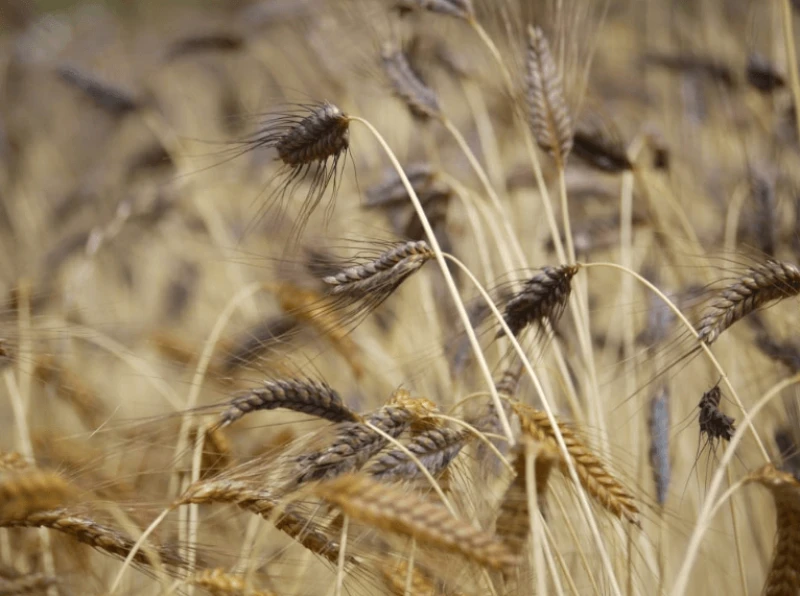
The world is getting hotter, causing shifts in seasonal patterns and increasing the amount of extreme weather such as severe droughts and heat waves, which can affect crop yields and food supplies. A recent study led by a researcher at the Friedman School of Nutrition Science and Policy at Tufts University found that the likelihood of extreme temperatures that could affect crop yields has increased significantly in wheat-producing regions of the U.S. and China.
The findings predict heat waves that happened approximately once every hundred years in 1981 are now likely to happen once every six years in the Midwestern U.S. and once every 16 years in Northeastern China. The work shows the range of conditions that people need to prepare for, even if they haven’t occurred yet.
“The historical record is no longer a good representation of what we can expect for the future,” said Erin Coughlan de Perez, CBF Professor at the Friedman School and lead author on the paper, which was published on June 2 in npj Climate and Atmospheric Science. “We live in a changed climate and people are underestimating current day possibilities for extreme events.”
According to the most recent report from the Intergovernmental Panel on Climate Change, the average global surface temperature in the last decade was 1.1 degrees Celsius higher than it was between 1850 and 1900. To evaluate how this has changed our risk of extreme weather, Coughlan de Perez and her colleagues collected a large group of seasonal forecasts from the past 40 years. They used this ensemble to generate thousands of possible variations in temperature and rainfall, essentially showing all the things that could have happened in a given year. With this method, known as the Unprecedented Simulated Extreme Ensemble or UNSEEN approach, the researchers were able to estimate the likely frequency of extreme temperatures that exceed critical growth thresholds for wheat.
Winter wheat crops start their growth in the fall and are harvested the following summer. High temperatures in spring, when the plant is flowering, can affect the wheat’s development. At temperatures over 27.8 degrees Celsius (about 82 degrees Fahrenheit), the plants start to suffer from heat stress. At temperatures over 32.8 degrees Celsius (about 91 degrees Fahrenheit), important enzymes in the wheat start to break down.
“In the Midwest, we used to have seasons where you’d see an average of maybe four or five days of that enzyme breakdown threshold being exceeded—it was pretty uncommon,” said Coughlan de Perez, who is also part of the Feinstein International Center at the Friedman School. “But our research showed possible alternative realities of today’s climate that generated 15 days above this threshold, which we surmise would be very damaging.”
Record-breaking heat also tends to be associated with record-breaking drought, Coughlan de Perez said. The combination of these two hazards could severely impact the growing season. Both the U.S. and China are considered global breadbaskets—areas that produce significant amounts of the world’s grains. If these crops were to fail simultaneously, or at the same time as other staple crops, it could have serious impacts on the price and availability of food around the world.
The results indicate that both regions have been lucky in recent years. There is an aspect of randomness to weather—a range of possibilities could occur, sort of like when you roll a six-sided die. So far, these regions have been rolling fairly low numbers, ending up with cooler weather than they could have had. But climate change has switched out the die—the highest number is bigger than it used to be. These regions haven’t experienced the full extent of what is possible, and they might not be ready for it.
“My hope is that we can tell people that their die has changed. You can roll something really extreme,” Coughlan de Perez said. “Maybe you won’t roll an eight for a while, but I think it’s worth having some plans in place for when that happens.”
The researchers also identified regional and global atmospheric circulation patterns that could lead to severely hot and dry events, including a possible worst-case scenario where wheat production in both the U.S. and China is hit hard in the same season. Their results can help inform climate adaptation plans in these regions and ensure that stakeholders can prepare for the unprecedented events to come.
“I think, with climate change, we’re suffering from a failure of imagination. If we’re not imagining the kinds of extremes that could happen, then we won’t prepare for them,” Coughlan de Perez said. “We don’t have to be surprised. We can use tools at our disposal to try to understand what’s possible and be ready when it happens.
This is an excerpt. Read the original post here













 Viewpoint — Fact checking MAHA mythmakers: How wellness influencers and RFK, Jr. undermine American science and health
 Viewpoint: Video — Big Solar is gobbling up productive agricultural land and hurting farmers yet providing little energy or sustainabilty gains
 Fighting deforestation with CO2: Biotechnology breakthrough creates sustainable palm oil alternative for cosmetics
 Trust issues: What happens when therapists use ChatGPT?
 California, Washington, Oregon forge immunization alliance to safeguard vaccine access against federal undermining
 30-year-old tomato line shows genetic resistance to devastating virus
 The free-range chicken dilemma: Better for birds, but with substantial costs
 ‘You have to treat the brain first’: Rethinking chronic pain with Sanjay Gupta