Tranding

802.11ax, the next generation of Wi-Fi which knows no bound and hence delivers higher levels of efficiency in existing Wi-Fi networks. 802.11ax is a successor of 802.11ac WiFi standard, which will be official by late 2019 but we can see its pre-standard presence in both enterprises and consumer WLAN market. 802.11ax is designed to cater to a large number of devices at once without compromising on speed and avoiding interference.
As IEEE unveils the next generation of Wi-Fi standard-802.11ax, it’s time to delve into the details of the brand new transport to launch ourselves onto the World Wide Web.
So what exactly is 802.11ax?
The 802.11ax is a WLAN standard that comes under the 802.11xx bracket. Specifically designed for Wi-fi the 802.11ax is designed to provide 4 times the throughput of the currently existing standard. This is proving to be one of the challenging, yet highly rewarding enhancements. This standard is developed for places, which usually have high device densities- like railway platforms, stadiums, shopping malls, and more. The Internet of Things can also be benefited. It is also developed for cellular data offloading. Offloading in layman terms is taking a detour to cheaper and faster Wi-Fi networks from the cellular networks. Thus the new standard promises improved performance, faster speed, extended coverage, and longer battery life.
According to John Byrne, Technology Analyst at GlobalData, “The 802.11ax standard will drive a significant boost in capacity, efficiency and flexibility that should make Wi-Fi align closely with emerging 5G priorities. The ability to support up to 12 simultaneous user streams from a single access point, 8×8 multi-user multiple inputs multiple outputs, and the use of much larger 80 MHz channels of wireless spectrum represent dramatic upgrades from the current state-of-the-art standard, 802.11ac.”
Differences between 802.11ax and 802.11ac
The question arises how this “ax” extension is superior to its “ac” partner. What advantages does 802.11ax actually offer over the existing 802.11ac standard?
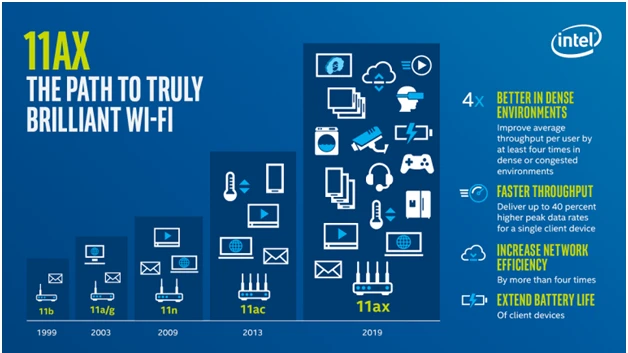
Intel describes this as:
“802.11ax is expected to deliver up to 40 percent higher peak data rates for a single client device, improve average throughput per user by at least four times in congested environments and increase network efficiency by more than four times.”
| 802.11ax | 802.11ac |
| OFDMA is used as the multiplexing technique. | OFDMA is not present. |
| Multi-user MIMO available in uplink and downlink. | Multi-user MIMO used only in the downlink. |
| Trigger-based random access in an uplink. | It is not available. |
| Spatial frequency reuse is done. | No spatial frequency reuse. |
| Target Wake time available. | Target Wake time not available. |
| Dynamic fragmentation. | Static fragmentation. |
| Operates in 2.4Ghz and 5Ghz. | Operates in 5Ghz only. |
Let us see the Key parameters of 802.11ax compared against 802.11ac.
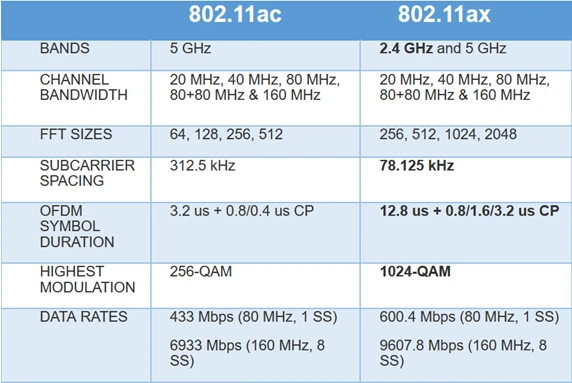
The 802.11ax combines different technologies to provide the aforementioned. It achieves a fair increase in throughput by using higher order QAM modulation technique. It also uses beamforming technology to aim download streams to target users.
802.11ax Pre-Standard Presence
The mass adoption of the latest standard may happen by 2020, but the promise it shows has awakened and freed the bottlenecks of wireless communication systems.






Be the first to know about new products and promotions.