
What Marvel Rivals Season 1 Hero Designs Mean For Role Queue
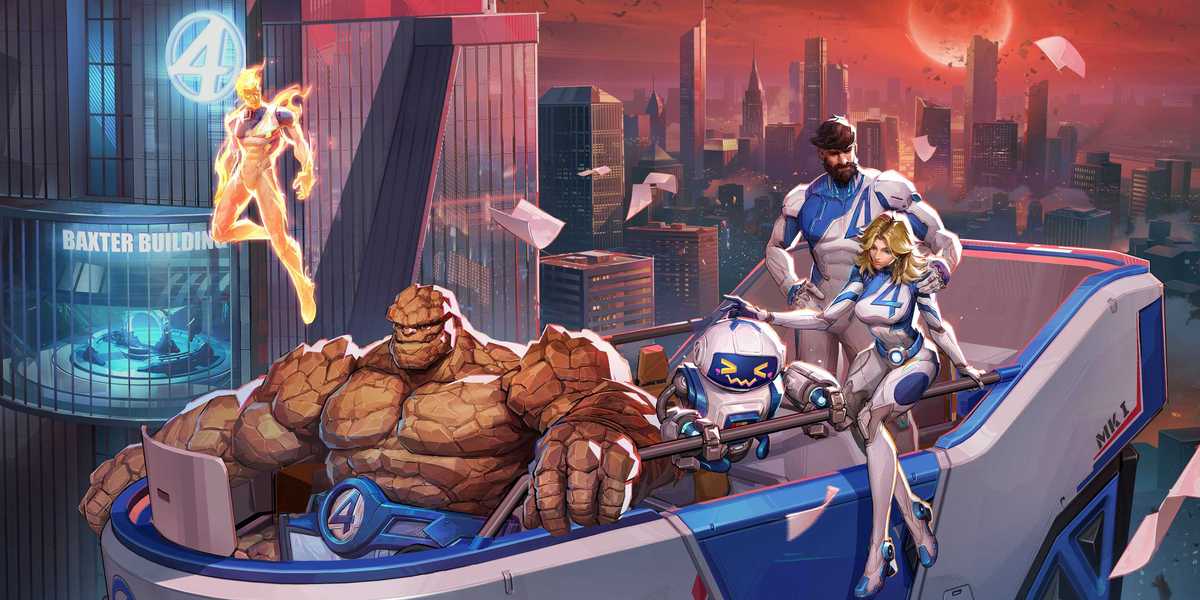
Marvel Rivals has just launched its first major content update with Season 1's release, and it could offer some meaningful insight as to how role queue would affect the game Season 1 sees the inclusion of new maps, characters, and balancing changes, with a primary focus on the beloved Fantastic Four family. Half of that family is already available, with Susan Storm and Reed Richards coming into Rivals within the strategist and duelist roles respectively. However, Mr. Fantastic, while being a duelist, seems to fulfill more of a diverse role, appearing to be the first hybrid hero in Marvel Rivals.
Hybrid heroes are a concept that Marvel Rivals can now point to as a measure of asymmetry among its relatively safe genre choices. Mr. Fantastic's inclusion not only anticipates further hero diversity but also re-frames the question of role queue. Initial discussions of role queue assumed a relatively static distinction between Rivals' three roles, but with the potential of more flexible heroes, role queue beccomes a more contentious idea. With Mr. Fantastic in mind, role queue could do more harm than good for competitive game modes, a limiting mechanic that could potentially snuff the creative applications of more unique heroes.
Hybrid Heroes Increase Composition Diversity
Mr. Fantastic Stretches Towards The Vanguard Role
Mr. Fantastic has come to Rivals with the most health among any duelist: a cool 350 that leaves him as the tankiest damage-dealer in the game. However, Mr. Fantastic's recently revealed abilities also involve an inflated form and access to self-shielding, which can see him reach an effective health higher than the majority of vanguards. Kit-wise, he has an elastic tether that can slam enemies into each other, as well as a projectile reflect. While Mr. Fantastic is labeled as a duelist, his primary benefit to a team will undoubtedly be his bulk and utility potential.
The nomenclature for team compositions is understood by the position of the numbers, the first being vanguard, the second duelist, and the third strategist. 1-3-2, then, would be one vanguard, three duelists, and two strategists.
It is no understatement to say that Mr. Fantastic has dramatically widened the possibilities for hero design, and by extension, composition diversity. Comps such as 1-3-2 and 3-1-2 could potentially see some play with Mr. Fantastic in use, who is certainly a more flexible choice. Brawl compositions, focused on getting into close-range team fights, could certainly benefit from extra bulk and CC potential of Mr. Fantastic, while other compositions may benefit from a more fine-tuned mixture of damage and survivability.
Role Queue May Limit Hero Diversity
Diverse Heroes And Enforced Compositions Do Not Mix Well

Mr. Fantastic's inclusion has certainly shaken the validity of roles. For such flexible heroes, the game's required placement of them into a specific role can be seen now as somewhat arbitrary. While this may seem minor, with Mr. Fantastic being the only case of this, the more heroes added in with a hybrid role, the more arbitrary the roles actually become. This poses no issues currently — the playerbase will adjust and find a purpose for Mr. Fantastic — but that purpose will likely be less defined by his role and more defined by what he offers the team individually.
"Currently" is the key distinction here. If role queue is added to Rivals with the purpose of more heavily stabilizing team compositions and match balance, hybrid heroes would pose a major gray area. If Mr. Fantastic's overall DPS is balanced lower to compensate for his utility and survivability, then players being forced to use two vanguards, as role queue would decide, may cause his play rate to plummet, as those benefits may be less desirable than pure kill potential.
Overall, if Marvel Rivals continues this trend of role hybridity, role queue will become increasingly unfeasible. Flexible hero designs will not mix well with inflexible team compositions. When heroes are designed not to fit within binary roles, deciding compositions by those same arbitrary binaries simply does not work.
Role Queue Does Not Appear To Be Coming Anytime Soon
Role Queue Is No Longer A Viable Solution To A Competitive Problem

Role queue, while still a hotly debated feature among the community, is still nowhere in sight for Marvel Rivals. However, the argument against role queue has certainly grown with Mr. Fantastic's entry into Rivals. If a choice needs to be made between a stabilized meta and ranked play experience, where imbalanced comps can decide a match quickly, and the creative freedom to make more distinct heroes and team-building decisions, the answer appears clear. Marvel Rivals should lean into the features that make it stand out from the genre.
The initial roster, with its inclusion of melee heroes, unlimited flying, and thematic but powerful mobility options, could be seen as a major selling point of Rivals. Similar to NetEase focusing on Marvel Rivals' unique map mechanics, a more diverse and exciting roster should be an aspect of the game that they lean into. Unfortunately, those unbalanced ranked games may need an alternative solution if this path is chosen, but ultimately, it's a worthy sacrifice for more creativity in Marvel Rivals.


Marvel Rivals
 OpenCritic Reviews
- Released
- December 6, 2024
- ESRB
- T For Teen // Violence
- Developer(s)
- NetEase Games
- Publisher(s)
- NetEase Games
- Engine
- Unreal Engine 5
- Multiplayer
- Online Multiplayer, Online Co-Op
- Cross-Platform Play
- Limited - console crossplay, no PC crossplay
- Franchise
- Marvel
- Platform(s)
- PlayStation 5, Xbox Series X, Xbox Series S, PC






Your comment has not been saved