Why do some people love salty foods? It could be because they ate a fat-rich diet as a child

The researchers used a rat model to investigate the effect on taste preference of a two-generational (i.e., pregnant mother and young newborns) exposure to a high-fat diet. Pregnant and lactating females were fed a high-fat diet, while a control group received a standard diet. After weaning, the offspring from each group received the same diet – babies from mothers fed a high-fat diet during pregnancy and those fed a standard diet continued receiving a high-fat diet and a standard diet, respectively.
Young rats from the high-fat diet groups gained more weight and consumed more energy than their counterparts from the standard diet groups. “We wondered if the different diets had affected the taste preferences of the rats,” explains Takashi Ono, senior author. “It is well established that taste impacts food intake. If something tastes good, the brain reward circuits are activated, and you will likely eat more of it.” The researchers tested the animal preference for the five basic tastes: bitter, sour, salty, sweet, and umami, using a two-bottle challenge, in which two bottles – one containing water and the other one water with taste – were added to the rat cage. Offspring exposed to a high-fat diet during gestation and early life preferred salty water. In contrast, they showed no specific preference for the other tastes when compared with the standard-diet group.
What mechanisms underlie this preference? The researchers investigated the levels of proteins involved in perceiving the salty taste. “The protein and gene expression of AT1 increased in the taste buds of female offspring exposed to a high-fat diet. This happened as early as three weeks after birth,” explains Saranya Serirukchutarungsee, lead author of the study. “AT1 is known to be associated with a preference for salty taste and evidence suggests that it is likely that AT1 affects the salty taste preference by increasing sodium intake in taste bud cells.”
Better understanding of the programming of offspring’s eating behavior and taste preferences is vital when considering the strong links between poor diet and poor health. These findings provide a crucial first step that can lead to further studies aimed at reducing the risk of developing obesity and diet-linked diseases, such as cardiovascular disease in offspring and subsequent generations.
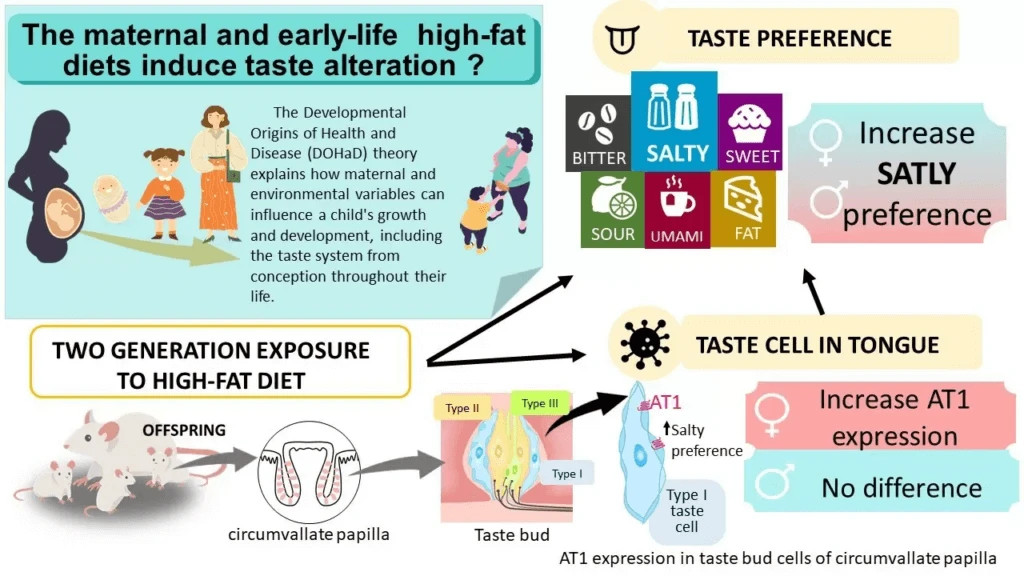
Maternal and early-life high-fat diets result in a taste for salty food
The Developmental Origins of Health and Disease (DOHaD) theory refers to the concept that maternal and environmental variables at a very early life stage can influence a child’s growth, development and health in later life. Maternal and early-life high-fat diets increase preference for salty taste, while there are no differences in bitter, sour, sweet, and umami tastes. The protein and gene expression of Angiotensin II receptor type 1 (AT1) in the taste buds of female offspring exposed to a high-fat diet is increased three weeks after birth. AT1 in taste bud cells relates to salty taste perception, and increasing AT1 in offspring’s taste bud cells affects the taste preference by increasing sodium intake.
The article, “Two-generation exposure to a high-fat diet induces the change of salty taste preference in rats,” was published in Scientific Reports at DOI: 10.1038/s41598-023-31662-0.
Read the original post here

 | Videos | More... |

Video: Nuclear energy will destroy us? Global warming is an existential threat? Chemicals are massacring bees? Donate to the Green Industrial Complex!
 | Bees & Pollinators | More... |

GLP podcast: Science journalism is a mess. Here’s how to fix it

Mosquito massacre: Can we safely tackle malaria with a CRISPR gene drive?

Are we facing an ‘Insect Apocalypse’ caused by ‘intensive, industrial’ farming and agricultural chemicals? The media say yes; Science says ‘no’
 | Infographics | More... |

Infographic: Global regulatory and health research agencies on whether glyphosate causes cancer
 | GMO FAQs | More... |

Why is there controversy over GMO foods but not GMO drugs?

How are GMOs labeled around the world?

How does genetic engineering differ from conventional breeding?
 | GLP Profiles | More... |

Alex Jones: Right-wing conspiracy theorist stokes fear of GMOs, pesticides to sell ‘health supplements’

 Viewpoint — Fact checking MAHA mythmakers: How wellness influencers and RFK, Jr. undermine American science and health
 Viewpoint: Video — Big Solar is gobbling up productive agricultural land and hurting farmers yet providing little energy or sustainabilty gains
 Fighting deforestation with CO2: Biotechnology breakthrough creates sustainable palm oil alternative for cosmetics
 Trust issues: What happens when therapists use ChatGPT?
 California, Washington, Oregon forge immunization alliance to safeguard vaccine access against federal undermining
 30-year-old tomato line shows genetic resistance to devastating virus
 The free-range chicken dilemma: Better for birds, but with substantial costs
 ‘You have to treat the brain first’: Rethinking chronic pain with Sanjay Gupta