World Economic Forum: How genetically engineered crops can fight climate change
World Economic Forum: How genetically engineered crops can fight climate change
Kevin Doxzen | World Economic Forum | July 8, 2022
XLinkedInFacebookRedditBlueskyThreads
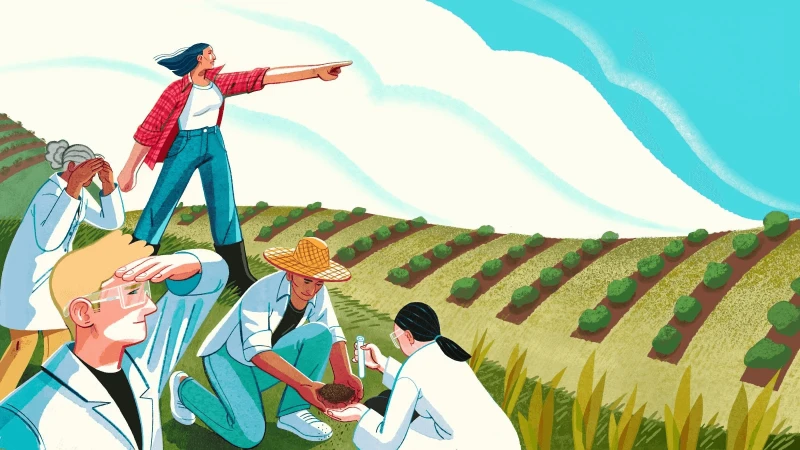
Credit: Ericka Lugo/Grist
Food systems account for over one-third of global greenhouse gas emissions. Any successful strategy for reaching the ambitious — and critical — emissions targets outlined in the Paris Agreement must involve changes to how we grow, process and distribute food.
The pursuit of net-zero can be divided into two parts. First, the reduction of greenhouse gas emissions to as close to zero as possible and second, the absorption of any remaining emissions from the atmosphere.
Agricultural land use is a key component in both sides of the net-zero equation. Decreasing the amount of land devoted to livestock will reduce methane emissions, while crops can be engineered to more efficiently capture carbon dioxide and turn it into oxygen or store it in the soil.
Follow the latest news and policy debates on sustainable agriculture, biomedicine, and other ‘disruptive’ innovations. Subscribe to our newsletter.
Engineered crops in the fight against climate change
Genetic engineering is already being used to help organisms adapt to rapidly changing climates. Researchers are developing strains of rice, maize and wheat capable of withstanding longer droughts and wetter monsoon seasons. Extreme temperatures are exposing crops to new fungi and pests, which is motivating scientists to genetically engineer disease-resistant cassava, potatoes and cacao.
Those same genetic engineering tools used for climate change adaptation are now being used for mitigation.
Researchers at the Innovative Genomics Institute have received funding from the Chan Zuckerberg Initiative to use CRISPR gene-editing technology to improve the ability of plants and soil microbes to capture and store carbon from the atmosphere in a variety of ways.
The National Science Foundation-funded Realizing Increased Photosynthetic Efficiency project found that by using genetic engineering to optimize photosynthesis — the process by which plants convert sunlight, water and carbon dioxide into oxygen and energy — they could create plants that were roughly 40% more productive, meaning less carbon dioxide in the atmosphere.
Roots can be engineered to be sturdier, larger and deeper, researchers at The Harnessing Plants Initiative at the Salk Institute for Biological Studies have found. By using a molecule found in avocado and cantaloupe skins, these engineered roots can better resist decomposition, minimizing carbon escape.
And microbes in the soil, too, can be harnessed to mitigate climate change and sequester carbon.
Up to 20% of the beneficial molecules that plants create during photosynthesis is shared through their roots with microbes living in soil. Using genetic engineering, researchers could adjust the communication and interplay between roots and microbial communities, helping to stabilize carbon in the soil — making sure it stays there.
Capturing carbon through other ecosystems
Agricultural land covers over one-third of global land surface. Using just a fraction of this space to more efficiently capture and store carbon through engineered crops would be instrumental in countries meeting their net-zero targets. And while some areas of research are currently at their early stages, other methods of biological carbon sequestration are closer to implementation and scaling.
For example, strategic reforestation on a global scale will be critical in mitigating the roughly 40 billion metric tons of carbon dioxide pumped into the atmosphere every year. In its lifetime, a single tree captures an average of 0.62 metric tons of carbon dioxide equivalent, so the scale of reforestation efforts must be truly industrial.
The ocean and “Blue carbon” ecosystems — salt marshes, mangroves, and seagrasses — are 10 times more effective at sequestering carbon dioxide on an area basis per year than tropical forests. They have the potential to absorb almost 1.4 billion tons of CO2 by 2050, and must be protected.
Grasslands also have great potential for carbon sequestration. In increasingly dry areas, grasslands can store more carbon than forests because they are less impacted by droughts and wildfires. They sequester most of their carbon underground, while trees store it mostly in wood and leaves that are susceptible to fire.
Preservation of these natural environments is a critical tool in the fight against climate change, and one that can be acted upon immediately.
The path forward
The latest from the United Nations’ Intergovernmental Panel on Climate Change made clear that carbon removal is an unavoidable part of reaching net zero emissions. Any successful strategy to reach net-zero emissions must and will involve biological and technological tools for capturing and storing carbon from the atmosphere.
How to utilize these tools should be informed by the latest science but also directed by communities. Determining what carbon capture tools to use and how to use them should not be left solely to scientists and policymakers, but people who are impacted by both climate change and its proposed solutions.
Listening to the stewards of ecosystems will ensure that genetically-engineered crops and other biological carbon capture methods meet the needs of the environment, local populations, and the wider global community.

















 Viewpoint — Fact checking MAHA mythmakers: How wellness influencers and RFK, Jr. undermine American science and health
 Viewpoint: Video — Big Solar is gobbling up productive agricultural land and hurting farmers yet providing little energy or sustainabilty gains
 Fighting deforestation with CO2: Biotechnology breakthrough creates sustainable palm oil alternative for cosmetics
 Trust issues: What happens when therapists use ChatGPT?
 California, Washington, Oregon forge immunization alliance to safeguard vaccine access against federal undermining
 30-year-old tomato line shows genetic resistance to devastating virus
 The free-range chicken dilemma: Better for birds, but with substantial costs
 ‘You have to treat the brain first’: Rethinking chronic pain with Sanjay Gupta